

Veiligere infrastructuur door lasers en AI
- MichielArnouts
Beeld je in: je rijdt door een tunnel en plots zie je voor je een stuk beton naar beneden vallen. En alsof dat nog niet genoeg is, sta je nu ook nog eens stil in de tunnel omdat het puin de weg verspert. Wat een nachtmerrie! Helaas kan dit voor sommigen werkelijkheid worden. En dat niet alleen in België, ook andere Europese landen kampen met dit probleem.
Artikel door Jasper Laforce & Michiel Arnouts
Momenteel worden tunnels en gebouwen van beton gecontroleerd met verschillende technieken. Sommige daarvan beschadigen het beton, bijvoorbeeld door er een stukje uit te boren en dat vervolgens te onderzoeken. Een andere methode is om met een hamer op het beton te tikken en te luisteren of het nog 'goed' klinkt. Maar er moet toch een betere manier zijn?
Het antwoord is ja, of beter gezegd: bijna. Twee studenten van de Universiteit Antwerpen, Michiel en Jasper, ontwikkelden voor hun masterproef een automatisch systeem dat schade in betonblokken kan detecteren. Dat doen ze door de blokken te laten trillen en vervolgens in die trillingen op zoek te gaan naar patronen die aangeven of er schade aanwezig is.
De studenten maakten zelf drie betonblokken: één zonder defecten en twee met kunstmatig aangebrachte defecten. In het ene blok verwerkten ze platen piepschuim om een defect genaamd 'delaminatie' na te bootsen. Bij delaminatie laten verschillende lagen beton als het ware van elkaar los. In het andere blok gebruikten ze opgerolde bubbeltjesplastic en oranje capsules uit Kinder Surprise-eitjes. Daarmee probeerden ze kleine, met lucht gevulde holtes in het beton na te bootsen.
Volledig automatisch meten
Om de trillingen te meten, gebruiken de studenten een contactloze trillingsmeter, een zogenaamde laser-Doppler-vibrometer. Met behulp van een laser meet dit toestel de trillingen van de betonblokken, zonder ze aan te raken. De meter is bijzonder nauwkeurig en kan zelfs trillingen meten die zo klein zijn als 1/50ste van de dikte van een haar.
Om de metingen volledig automatisch te laten verlopen, maken de studenten gebruik van een beweegbare spiegel die de laser in de juiste richting stuurt. Deze spiegel beweegt zelfstandig en richt de laser op vooraf bepaalde punten op het betonblok. Zo kunnen de studenten systematisch het volledige oppervlak meten, zonder de laser telkens handmatig te moeten verplaatsen.
Om de betonblokken te laten trillen, gebruiken ze een luchtdrukkanon dat kleine stalen balletjes op de blokken schiet. Het kanon kan zowel zijwaarts als omhoog bewegen, zodat ook het schieten volledig automatisch kan gebeuren. Zelfs het herladen verloopt zonder menselijke tussenkomst.
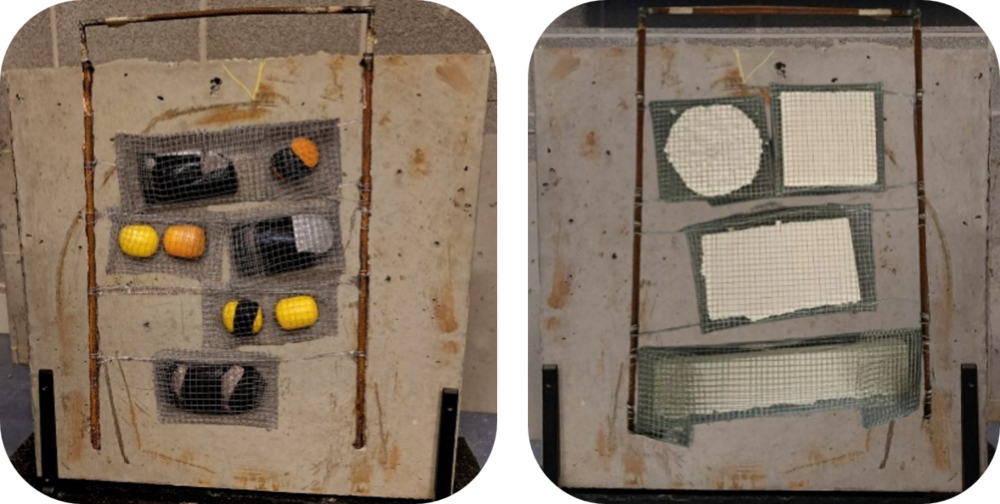
De twee betonblokken met daarin de nagebootste defecten.
"Het automatisch bewegen en afvuren van het kanon is een groot voordeel, vooral voor de snelheid en nauwkeurigheid van de metingen. Bovendien kan je zo niet per ongeluk op een groepsgenoot schieten, wat heel misschien al eens gebeurd is" - Jasper, student aan de UAntwerpen
Om de schade te detecteren, maakten de studenten gebruik van artificiële intelligentie (AI). Ze testten twee verschillende AI-modellen en onderzochten welk model het beste werkte. Vervolgens trainden ze het gekozen model met de verzamelde trillingsmetingen. Zo leerde het model patronen in de trillingen herkennen die wijzen op de aanwezigheid van schade.
Een nauwkeurigheid van 97,7%
Uiteindelijk bleek het AI-model succesvol: het kon de verschillende soorten schade herkennen met een nauwkeurigheid van 97,7%. Omdat de studenten de locaties van de metingen bijhielden, konden ze de voorspellingen van het AI-model ook omzetten in een visuele kaart. Die kaart konden ze vervolgens vergelijken met de werkelijke locatie van de defecten in de betonblokken.

De AI voorspelt waar de defecten zich bevinden. Links zie je de werkelijke defecten, rechts de voorspellingen van het model.
"Het automatisch laten trillen en meten van beton is op deze manier nog niet eerder gedaan. Er is nog wel wat werk aan de winkel om deze techniek praktisch toepasbaar te maken voor echte inspecties, maar we hebben wel bewezen dat het mogelijk is. We zijn intussen benaderd door een bedrijf dat hier verder onderzoek naar wil doen. We werken nu met hen samen om te helpen deze technologie op de markt te brengen."
Dus als je over een paar jaar nog eens door een tunnel rijdt en je ziet mensen met een laser en een kanon dat balletjes afschiet, hoef je niet meteen te schrikken. Ze zijn waarschijnlijk aan het meten om ervoor te zorgen dat je veilig door de tunnel kunt blijven rijden.
Bibliografie
[1] Christoph Kralovec and Martin Schagerl. “Review of Structural Health Monitoring Methods Re
garding a Multi-Sensor Approach for Damage Assessment of Metal and Composite Structures”.
In: Sensors 20.3 (2020), p. 826. doi: 10.3390/s20030826.
[2] Diego A. Tibaduiza Burgos et al. “Damage Identification in Structural Health Monitoring: A
Brief Review from its Implementation to the Use of Data-Driven Applications”. In: Sensors 20.3
(2020), p. 733. doi: 10.3390/s20030733.
[3] Onur Avci et al. “A review of vibration-based damage detection in civil structures: From tradi
tional methods to Machine Learning and Deep Learning applications”. In: Mechanical Systems
and Signal Processing 147 (2021), p. 107077. doi: 10.1016/j.ymssp.2020.107077.
[4] Jing Jia and Ying Li. “Deep Learning for Structural Health Monitoring: Data, Algorithms, Ap
plications, Challenges, and Trends”. In: Sensors 23.21 (2023), p. 8824. doi: 10.3390/s23218824.
[5] Masayasu Muramatsu, Shigeaki Uchida, and Yasuo Takahashi. “Noncontact Detection of Con
crete Flaws by Neural Network Classification of Laser Doppler Vibrometer Signals”. In: Engi
neering Research Express 2.2 (2020), p. 025017. doi: 10.1088/2631-8695/ab8ba4.
[6] Hossein Taheri, Maria Gonzalez Bocanegra, and Mohammad Taheri. “Artificial Intelligence, Ma
chine Learning and Smart Technologies for Nondestructive Evaluation”. In: Sensors 22.11 (2022),
p. 4055. doi: 10.3390/s22114055.
[7] Mohsen Azimi, Armin Dadras Eslamlou, and Gokhan Pekcan. “Data-Driven Structural Health
Monitoring and Damage Detection through Deep Learning: State-of-the-Art Review”. In: Sensors
20.10 (2020), p. 2778. doi: 10.3390/s20102778.
[8] B. Koehler, G. Hentges, and W. Mueller. “Improvement of ultrasonic testing of concrete by com
bining signal conditioning methods, scanning laser vibrometer and space averaging techniques”.
In: NDT & E International 31.4 (1998), pp. 281–287. doi: 10.1016/S0963-8695(98)00005-X.
[9] D. Algernon et al. “Imaging of the elastic wave propagation in concrete using scanning tech
niques: Application for impact-echo and ultrasonic echo methods”. In: Journal of Nondestructive
Evaluation 27.1–3 (2008), pp. 83–97. doi: 10.1007/s10921-008-0034-4.
[10] Ryo Akamatsu et al. “Proposal of Non Contact Inspection Method for Concrete Structures Using
High-Power Directional Sound Source and Scanning Laser Doppler Vibrometer”. In: Japanese
Journal of Applied Physics 52.7S (2013), 07HC12. doi: 10.7567/JJAP.52.07HC12.
[11] Tsuneyoshi Sugimoto. “Non-Destructive Inspection of Concrete Structures by Noncontact Acous
tic Inspection Technology Using Acoustic Irradiation Induced Vibration”. In: IEICE ESS Fun
damentals Review 16.3 (2023), pp. 156–166. doi: 10.1587/essfr.16.3_156.
[12] Naotoshi Yasuda et al. “Detection and characteristics estimation of defects in concrete structures
using laser ablation-induced vibration”. In: Tunnelling and Underground Space Technology 103
(2020), p. 103460. doi: 10.1016/j.tust.2020.103460.
[13] Johannes F. Scherr et al. “Detection of Delaminations in Concrete Plates Using a Laser Ablation
Impact Echo Technique”. In: Journal of Nondestructive Evaluation 42 (2023), p. 11. doi: 10.
1007/s10921-022-00921-x.
[14] Michiel Arnouts et al. Non-Contact Damage Detection in Concrete Using Laser Doppler Vibrom
etry and Various Excitation Methods. Preprints.org. Preprint. 2026. doi: 10.3390/metrology6020035.
[15] Xu Tian et al. “An Internal Defect Detection Algorithm for Concrete Blocks Based on Local
Mean Decomposition-Singular Value Decomposition and Weighted Spatial-Spectral Entropy”.
In: Entropy 25.7 (2023), p. 1034. doi: 10.3390/e25071034.
[16] Hongyun Yang et al. “Experimental research on remote non-contact laser vibration measurement
for tunnel lining cavities”. In: Scientific Reports 15 (2025), p. 105. doi: 10.1038/s41598-024
83819-0.
[17] Kazuko Sugimoto et al. “Detection of resonance frequency of both the internal defects of concrete
and the laser head of a laser Doppler vibrometer by spatial spectral entropy for noncontact
acoustic inspection”. In: Japanese Journal of Applied Physics 58 (2019), SGGB15. doi: 10.
7567/1347-4065/ab1a2f.
47
[18] KazukoSugimoto and Tsuneyoshi Sugimoto. “Detection of Internal Defects in Concrete and Eval
uation of a Healthy Part of Concrete by Noncontact Acoustic Inspection Using Normalized Spec
tral Entropy and Normalized SSE”. In: Entropy 24.2 (2022), p. 142. doi: 10.3390/e24020142.
[19] Marek Slo´nski, Krzysztof Schabowicz, and Ewa Krawczyk. “Detection of Flaws in Concrete Using
Ultrasonic Tomography and Convolutional Neural Networks”. In: Materials 13.7 (2020), p. 1557.
doi: 10.3390/ma13071557.
[20] Tianyu Hu et al. “Ultrasonic based concrete defects identification via wavelet packet transform
and GA-BP neural network”. In: PeerJ Computer Science 7 (2021), e635. doi: 10.7717/peerj
cs.635.
[21] Jinhui Zhao, Tianyu Hu, and Qichun Zhang. “A Wavelet Packet Transform and Convolutional
Neural Network Method Based Ultrasonic Detection Signals Recognition of Concrete”. In: Sen
sors 22.10 (2022), p. 3863. doi: 10.3390/s22103863.
[22] Xu Tian et al. “Concrete Multi-Type Defect Classification Algorithm Based on MSSMA-SVM”.
In: Sensors 22.23 (2022), p. 9145. doi: 10.3390/s22239145.
[23] Jasper Laforce. “Simulating the frequency response of decaying concrete slabs vs healthy concrete
slabs in Siemens NX”. Unpublished manuscript, Mechanical Systems, Universiteit Antwerpen.
2025.
[24] OVAM. Wat is verboden? 2026.
[25] OVAM. Asbest en uw gezondheid. 2026.
[26] ACI Committee 228. Report on Nondestructive Test Methods for Evaluation of Concrete in
Structures. Tech. rep. ACI 228.2R-13. Farmington Hills, MI: American Concrete Institute, 2013.
[27] V. M. Malhotra and Nicholas J. Carino, eds. Handbook on Nondestructive Testing of Concrete.
2nd ed. Boca Raton, FL: CRC Press, 2004. isbn: 9780849314858.
[28] ASTMInternational. ASTM C597-22: Standard Test Method for Ultrasonic Pulse Velocity Through
Concrete. West Conshohocken, PA: ASTM International, 2022. url: https://www.astm.org/
c0597-22.html.
[29] Jinhui Zhao et al. “Defect Recognition in Concrete Ultrasonic Detection Based on Wavelet Packet
Transform and Stochastic Configuration Networks”. In: IEEE Access 9 (2021), pp. 9284–9295.
doi: 10.1109/ACCESS.2021.3050715.
[30] Lara Guizi Anoni, Vladimir Guilherme Haach, and Lev Khazanovich. “Image Reconstruction
in Concrete Ultrasound Tomography: A Systematic Review”. In: Construction and Building
Materials 441 (2024), p. 137472. doi: 10.1016/j.conbuildmat.2024.137472.
[31] M. R. Clark, D. M. McCann, and M. C. Forde. “Application of Infrared Thermography to the
Non-Destructive Testing of Concrete and Masonry Bridges”. In: NDT & E International 36.4
(2003), pp. 265–275. doi: 10.1016/S0963-8695(02)00060-9.
[32] J. H. A. Rocha and Y. V. P´ovoas. “Infrared Thermography as a Non-Destructive Test for the
Inspection of Reinforced Concrete Bridges: A Review of the State of the Art”. In: Revista AL
CONPAT 7.3 (2017), pp. 200–214. doi: 10.21041/ra.v7i3.223.
[33] Seong-Hoon Kee et al. “Nondestructive Bridge Deck Testing with Air-Coupled Impact-Echo
and Infrared Thermography”. In: Journal of Bridge Engineering 17.6 (2012), pp. 928–939. doi:
10.1061/(ASCE)BE.1943-5592.0000350.
[34] Mary J. Sansalone and William B. Streett. Impact-Echo: Nondestructive Evaluation of Concrete
and Masonry. Jersey Shore, PA: Bullbrier Press, 1997. isbn: 9780961261061.
[35] Nicholas J. Carino. “The Impact-Echo Method: An Overview”. In: Proceedings of the 2001 Struc
tures Congress and Exposition. Washington, DC, 2001.
[36] ASTM International. ASTM C1383-15(2022): Standard Test Method for Measuring the P-Wave
Speed and the Thickness of Concrete Plates Using the Impact-Echo Method. West Conshohocken,
PA: ASTM International, 2022. url: https://www.astm.org/c1383-15r22.html.
[37] Paolo Castellini, Milena Martarelli, and Enrico P. Tomasini. “Laser Doppler Vibrometry: Devel
opment of Advanced Solutions Answering to Technology’s Needs”. In: Mechanical Systems and
Signal Processing 20.6 (2006), pp. 1265–1285. doi: 10.1016/j.ymssp.2005.11.015.
48
[38] Jing-Kui Zhang, Weizhong Yan, and De-Mi Cui. “Concrete Condition Assessment Using Impact
Echo Method and Extreme Learning Machines”. In: Sensors 16.4 (2016), p. 447. doi: 10.3390/
s16040447.
[39] Faezeh Jafari and Sattar Dorafshan. “Comparison between Supervised and Unsupervised Learn
ing for Autonomous Delamination Detection Using Impact Echo”. In: Remote Sensing 14.24
(2022), p. 6307. doi: 10.3390/rs14246307.
[40] Sattar Dorafshan and Hoda Azari. “Deep Learning Models for Bridge Deck Evaluation Using
Impact Echo”. In: Construction and Building Materials 263 (2020), p. 120109. doi: 10.1016/j.
conbuildmat.2020.120109.
[41] Feng Qu et al. “Structural damage identification and classification from time-frequency im
pact echo data using deep learning”. In: Nondestructive Testing and Evaluation 40.11 (2025),
pp. 5341–5362. doi: 10.1080/10589759.2024.2440816.
[42] Michael Kobusch, Ludwig Klaus, and Luis Mu˜niz Mendoza. “Investigation of Impact Hammer
Calibrations”. In: Proceedings of the 23rd IMEKO TC3, 13th TC5 and 4th TC22 International
Conference. Helsinki, Finland, 2017.
[43] Bernd Koehler, G. Hentges, and W. Mueller. “Improvement of Ultrasonic Testing of Concrete
by Combining Signal Conditioning Methods, Scanning Laser Vibrometer and Space Averaging
Techniques”. In: NDT & E International 31.4 (1998), pp. 281–287. doi: 10.1016/S0963
8695(98)00005-X.
[44] Yutaka Nakagawa et al. “Study on Concrete Internal Defect Detection from a Moving Cart
Equipped with LDVs and a Sound Source”. In: 2023 IEEE International Ultrasonics Symposium
(IUS). IEEE, 2023, pp. 1–4. doi: 10.1109/IUS51837.2023.10306719.
[45] Xu Tian et al. “An Internal Defect Detection Algorithm for Concrete Blocks Based on Local
Mean Decomposition-Singular Value Decomposition and Weighted Spatial-Spectral Entropy”.
In: Entropy 25.7 (2023), p. 1034. doi: 10.3390/e25071034.
[46] Hongyun Yang et al. “Experimental Research on Remote Non-Contact Laser Vibration Measure
ment for Tunnel Lining Cavities”. In: Scientific Reports 15 (2025), p. 105. doi: 10.1038/s41598
024-83819-0.
[47] Kazuko Sugimoto et al. “Detection of Resonance Frequency of Both the Internal Defects of
Concrete and the Laser Head of a Laser Doppler Vibrometer by Spatial Spectral Entropy for
Noncontact Acoustic Inspection”. In: Japanese Journal of Applied Physics 58 (2019), SGGB15.
doi: 10.7567/1347-4065/ab1a2f.
[48] Julius S. Bendat and Allan G. Piersol. Random Data: Analysis and Measurement Procedures.
4th ed. Hoboken, NJ: Wiley, 2010. isbn: 9780470248775.
[49] David J. Ewins. Modal Testing: Theory, Practice and Application. 2nd ed. Baldock, England:
Research Studies Press, 2000. isbn: 9780863802188.
[50] Alan V. Oppenheim and Ronald W. Schafer. Discrete-Time Signal Processing. 3rd ed. Upper
Saddle River, NJ: Pearson, 2010. isbn: 9780131988422.
[51] Christopher M. Bishop. Pattern Recognition and Machine Learning. Information Science and
Statistics. New York: Springer, 2006. isbn: 978-0-387-31073-2.
[52] Ian Goodfellow, Yoshua Bengio, and Aaron Courville. Deep Learning. Cambridge, MA: MIT
Press, 2016. isbn: 978-0-262-03561-3. url: https://www.deeplearningbook.org/.
[53] Andrew L. Maas, Awni Y. Hannun, and Andrew Y. Ng. “Rectifier Nonlinearities Improve Neural
Network Acoustic Models”. In: Proceedings of the 30th International Conference on Machine
Learning. 2013. url: https://ai.stanford.edu/~amaas/papers/relu_hybrid_icml2013_
final.pdf.
[54] Dan Hendrycks and Kevin Gimpel. “Gaussian Error Linear Units (GELUs)”. In: arXiv preprint
arXiv:1606.08415 (2016). url: https://arxiv.org/abs/1606.08415.
[55] Nitish Srivastava et al. “Dropout: A Simple Way to Prevent Neural Networks from Overfitting”.
In: Journal of Machine Learning Research 15.56 (2014), pp. 1929–1958. url: https://jmlr.
org/papers/v15/srivastava14a.html.
49
[56] Sergey Ioffe and Christian Szegedy. “Batch Normalization: Accelerating Deep Network Training
by Reducing Internal Covariate Shift”. In: Proceedings of the 32nd International Conference on
Machine Learning. Vol. 37. Proceedings of Machine Learning Research. 2015, pp. 448–456. url:
https://proceedings.mlr.press/v37/ioffe15.html.
[57] Geoffrey E. Hinton and Ruslan R. Salakhutdinov. “Reducing the Dimensionality of Data with
Neural Networks”. In: Science 313.5786 (2006), pp. 504–507. doi: 10.1126/science.1127647.
[58] Yang Deng et al. “Abnormal data detection for structural health monitoring: State-of-the-art
review”. In: Developments in the Built Environment 17 (2024), p. 100337. doi: 10.1016/j.
dibe.2024.100337.
[59] Jan Stoop. Labo beproeven van bouwmaterialen: Practica B1+B2. Last accessed 5 December
2025. 2024.
[60] Wang Gong-bao et al. “A precise algorithm for non-integer harmonics analysis based on FFT
and neural network”. en. In: Wuhan Univ. J. Nat. Sci. 9.4 (July 2004), pp. 454–458. doi: 10.
1007/BF02830442.
[61] Kui Fu Chen and Yan Feng Li. “Combining the Hanning windowed interpolated FFT in both
directions”. en. In: Comput. Phys. Commun. 178.12 (June 2008), pp. 924–928. doi: 10.1016/j.
cpc.2008.02.008.
[62] Gamze Cabadag, Ali Degirmenci, and Omer Karal. “Comparative analysis of interpolation tech
niques for FFT-based frequency estimation”. In: J. Univers. Comput. Sci. 32.2 (Feb. 2026),
pp. 267–285.
[63] Chi Lu and Yoshimi Sonoda. “Application of light-weighted CNN for diagnosis of internal con
crete defects using hammering sound”. In: Nondestructive Testing and Evaluation 39.8 (2024),
pp. 2426–2449. doi: 10.1080/10589759.2023.2301032.
[64] Florian Dethof and Sylvia Kessler. “Automated honeycomb detection during Impact Echo in
spections in concrete using AI trained by simulation data”. In: ReJNDT 1.1 (2023).
[65] Addisson Salazar and Arturo Serrano. “Automatic classification of impact-echo spectra I”. In:
Encyclopedia of Artificial Intelligence. IGI Global, 2009, pp. 192–198.
[66] Sattar Dorafshan and Hoda Azari. “Deep learning models for bridge deck evaluation using im
pact echo”. In: Construction and Building Materials 263 (2020), p. 120109. doi: 10.1016/j.
conbuildmat.2020.120109.
[67] Faezeh Jafari and Sattar Dorafshan. “Comparison between Supervised and Unsupervised Learn
ing for Autonomous Delamination Detection Using Impact Echo”. In: Remote Sensing 14.24
(2022), p. 6307. doi: 10.3390/rs14246307.
[68] Jing-Kui Zhang, Weizhong Yan, and De-Mi Cui. “Concrete Condition Assessment Using Impact
Echo Method and Extreme Learning Machines”. In: Sensors 16.4 (2016), p. 447. doi: 10.3390/
s16040447.
[69] E. Protopapadakis et al. “Autonomous robotic inspection in tunnels”. In: ISPRS Annals of the
Photogrammetry, Remote Sensing and Spatial Information Sciences III-5 (2016), pp. 167–174.
doi: 10.5194/isprsannals-III-5-167-2016.
[70] Juan G. Victores et al. “Robot-aided tunnel inspection and maintenance system by vision and
proximity sensor integration”. In: Automation in Construction 20.5 (2011), pp. 629–636. doi:
10.1016/j.autcon.2010.12.005.
[71] Michael Kobusch et al. “Investigation of Impact Hammer Calibrations”. In: Proceedings of the
23rd IMEKO TC3 Conference. 2017, pp. 1–6.
[72] Sho Wakata et al. “Defect detection of concrete in infrastructure based on Rayleigh wave propa
gation generated by laser-induced plasma shock waves”. In: International Journal of Mechanical
Sciences 218 (2022), p. 107039. doi: 10.1016/j.ijmecsci.2021.107039.





