

Proef jij zoet?
- SiskaVanderheyden
Wist je dat bij volwassenen gemiddeld 18% van hun energie-inname uit suikers bestaan? Bij kinderen loopt dit zelfs op tot 23%. (1) In onze bachelorproef gingen we op zoek naar sensorische methoden om minder suiker te eten en toch van een volle smaak te genieten. Sensoriek gaat over hoe we voeding ervaren met onze zintuigen: hoe we het zien, ruiken, proeven, voelen en horen.
Op basis daarvan ontwikkelden we de workshop ‘Proef jij zoet?’. Hiervoor doken we in de wetenschappelijke literatuur, bevroegen we diëtisten en testten we de workshop bij een groep van 9 diëtisten. Via sensorische technieken analyseerden deelnemers hoe onze zintuigen bepalen wat we proeven.

Zet een wasknijper op je neus en eet iets zoets … proef jij zoet?
 De workshop startte met een opvallend experiment: een groep diëtisten met een wasknijper op hun neus, klaar om een snoepje te proeven. Het leek eenvoudig, tot ze het snoepje effectief in hun mond staken. “Ik proef… bijna niks,” zei iemand verbaasd. Maar zodra de wasknijper afging, veranderde de ervaring. Het snoepje smaakte plots veel zoeter, voller en herkenbaarder. De geur bleek een belangrijke rol te spelen in de totale smaakbeleving.
Smaakexperimenten met cake. Proef jij het verschil?
Diezelfde verwondering zagen we bij de cakeproef. We maakten verschillende cakes, waaronder varianten met 50% minder suiker. Sommige kregen een vleugje vanille, banaan of een laagje honing dat tijdens het bakken licht karamelliseerde.
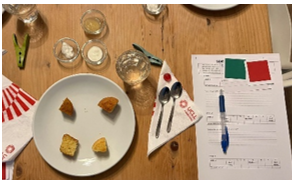
De diëtisten wisten vooraf niet welke variant ze kregen. De klassieke cake scoorde het hoogst, maar de gereduceerde versies werden verrassend positief beoordeeld, vooral die met honing en vanille. De combinatie van aroma, textuur en mondgevoel bleek minstens zo belangrijk als de suiker zelf.

De kracht van mindful eten
Tijdens een moment van mindful eten vertraagde alles. Deelnemers namen een hap en mochten pas na enkele seconden bewust proeven. Een minder zoete cake werd plots als “rijker” en “complexer” ervaren. Niet omdat het recept veranderde, maar omdat de aandacht veranderde. Het maakte duidelijk dat smaak niet alleen in het product zit, maar ook in de manier waarop je proeft.
En het resultaat?
Door mensen te laten ervaren hoe geur, kleur, textuur, mondgevoel en aandacht hun smaak beïnvloeden, ontstaan nieuwe mogelijkheden om suiker te verminderen zonder in te boeten aan smaak. Wat deelnemers vooral meenamen? Combineer het verlagen van suiker in een product met sensorische technieken. Minder suiker toevoegen is echt haalbaar.
Die boodschap sluit aan bij een belangrijke onderzoeksbevinding: zoetheid is verrassend persoonlijk. Wat voor de ene persoon heel zoet smaakt, kan voor een ander net zoet genoeg zijn.
Zoet proeven met al je zintuigen
Naast smaak spelen ook andere eigenschappen een belangrijke rol in hoe zoet iets wordt ervaren. Zo kunnen herkenbare aroma’s zoals vanille, kaneel, cacao, karamel, fruit of honing de zoetbeleving versterken. Ook kleur en presentatie beïnvloeden hoe zoet we iets verwachten te proeven: een goudbruin koekje lijkt vaak zoeter dan een lichte variant. Ook een rode kleur, zoals van aardbei of kers, versterkt de verwachting van zoetheid. Daarnaast beïnvloedt temperatuur de smaakwaarneming: warme producten, zoals warme appelmoes of havermout, worden doorgaans zoeter ervaren dan koude. Door bewust te spelen met geur, smaak, kleur en temperatuur kan de zoetbeleving dus worden versterkt.
Zoetstoffen: de oplossing voor minder suiker?
In deze bachelorproef werd er bewust voor gekozen om de suikerreductie te onderzoeken via sensorische technieken in plaats van uitsluitend via het gebruik van zoetstoffen. Zo kan de zoetbeleving worden behouden zonder suiker één op één te vervangen.
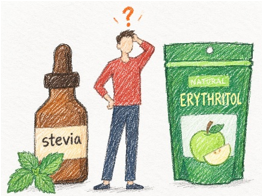
Zoetstoffen worden vaak gebruikt als alternatief voor suiker, maar ze kunnen niet altijd alle functies van suiker overnemen. Intensieve zoetstoffen (zoals aspartaam of stevia) leveren een sterke zoete smaak in zeer kleine hoeveelheden, maar dragen nauwelijks bij aan volume, textuur of mondgevoel. Extensieve zoetstoffen of polyolen (zoals erythritol en xylitol) kunnen deze eigenschappen beter benaderen, maar kunnen een koelende nasmaak geven en bij hogere innames darmklachten veroorzaken. Daarom vormen sensorische technieken een interessante aanvullende strategie om suiker te verminderen, zonder volledig afhankelijk te zijn van zoetstoffen.
Van bachelorproef naar navorming
Op basis van de feedback werd de workshop verfijnd met meer praktijkvoorbeelden, materialen op punt gezet en een overzicht van sensorische technieken. Zo groeide ‘Proef jij zoet?’ uit tot een praktijkgerichte navorming voor diëtisten, die vandaag wordt aangeboden door het UCLL Expertisecentrum Health Innovation. Tijdens deze navorming krijgen diëtisten concrete sensorische technieken aangereikt die ze meteen kunnen toepassen in hun begeleiding rond suikerreductie.
Besluit: een andere kijk op zoet
Suiker verminderen betekent dus niet simpelweg: suiker eruit en klaar. Het gaat om de juiste balans tussen minder suiker en toch blijven genieten van wat je eet.
Onze zintuigen spelen daarbij een grotere rol dan je misschien denkt. Ze beïnvloeden wat we verwachten, hoe we iets proeven en zelfs of we iets lekker vinden.
Minder suiker betekent dus niet minder genieten. Zet je zintuigen wat meer aan het werk, want lekker eten draait uiteindelijk om veel meer dan alleen zoet.
Bibliografie
1. Sciensano. Voedselconsumptiepeiling 2022–2023: evaluatie van de inname van macro- en micronutriënten bij de Belgische bevolking. Sciensano; 2024. Brussel, België.
2. Hoge Gezondheidsraad. Voedingsaanbevelingen voor de Belgische bevolking – 2025. Brussel: HGR; 2025. Advies n° 9805-9807.
3. European Union. Verordening (EU) nr. 1169/2011 betreffende de verstrekking van voedselinformatie aan consumenten. Geconsolideerde tekst; 2025. Beschikbaar via: https://eur-lex.europa.eu/legal-content/NL/TXT/HTML/?uri=CELEX:02011R11…. Geraadpleegd 2025 Nov 19.
4. Meulemans A, De Henauw S, Vanhauwaert E, De Preter V, Matthys C, Van Loo M. Handboek Voeding. 3rd ed. Leuven: Acco; 2025. 97–107 p.
5. Belorkar SA, Gupta AK. Oligosaccharides: a boon from nature’s desk. AMB Express 2016, 6(1):82.
6. Arshad MT, Maqsood S, Altalhi R, Shamlan G, Mohamed Ahmed IA, Ikram A, et al. Role of Dietary Carbohydrates in Cognitive Function: A Review. Food Sci Nutr 2025, 13(7):e70516.
7. Gezond leven. Hoeveel suikers zitten er in jouw dag verstopt? Beschikbaar via: https://www.gezondleven.be/nieuws/hoeveel-suikers-zitten-er-in-jouw-dag…. Geraadpleegd 2025 Nov 23.
8. Hoge Gezondheidsraad. Voedingsaanbevelingen voor België - 2016. Brussel: HGR; 2016. Advies nr. 928. 2016, .
9. Drieskens S, Charafeddine R, Braekman E. Gezondheidsenquête 2023-2024: voedingsgewoonten. Brussel, België; 2025 [cited 2025 Nov 24].
10. De Ridder K, Bel S, Brocatus L, Lebacq T, Moyersoen I, Ost C, et al. De consumptie van voedings middelen en de inname van voedingsstoffen. In: Bel S, Tafforeau J (ed.). Voedselconsumptiepeiling 2014-2015. Rapport 4. WIV-ISP, Brussel, 2016.
11. Stichting Food-Info. Bronnen van suiker [Internet]. Nederland: Food-Info.net; [geciteerd 2026 Jan 29]. Beschikbaar via: https://www.food-info.net/nl/products/sugar/sources.htm?utm_source=chat…. Geraadpleegd 2025 Oct 17.
12. Cosun Nutrition Center. Cosun Nutrition Center – informatieplatform. Beschikbaar via: https://cosunnutritioncenter.com/. Geraadpleegd 2025 Dec 1.
13. Pettai H, Oja V, Freiberg A, Laisk A. The long-wavelength limit of plant photosynthesis. FEBS Lett 2005, 579(18):4017–4019.
14. Nordzucker. Sugar production. Beschikbaar via: https://www.nordzucker.com/en/sugar-expertise-products/knowledge-about-…. Geraadpleegd 2025 Oct 30.
15. Augustin LSA, Kendall CWC, Jenkins DJA, Willett WC, Astrup A, Barclay AW, et al. Glycemic index, glycemic load and glycemic response: An International Scientific Consensus Summit from the International Carbohydrate Quality Consortium (ICQC). Nutrition, Metabolism and Cardiovascular Diseases 2015, 25(9):795–815.
16. Vrolix R, Mensink RP. Variability of the glycemic response to single food products in healthy subjects. Contemp Clin Trials. 2010 Jan;31(1):5-11. doi: 10.1016/j.cct.2009.08.001.
17. Atkinson FS, Foster-Powell K, Brand-Miller JC. International Tables of Glycemic Index and Glycemic Load Values: 2008. Diabetes Care 2008, 31(12):2281.
18. Asghar MT, Yusof YA, Mokhtar MN, Ya’acob ME, Mohd. Ghazali H, Chang LS, et al. Coconut (Cocos nucifera L.) sap as a potential source of sugar: Antioxidant and nutritional properties. Food Sci Nutr 2019, 8(4):1777.
19. Tappy L. Metabolism of sugars: A window to the regulation of glucose and lipid homeostasis by splanchnic organs. Clin Nutr. 2021 Apr;40(4):1691-1698. doi: 10.1016/j.clnu.2020.12.022. Epub 2020 Dec 21. PMID: 33413911.
20. Kierans SJ, Taylor CT. Glycolysis: A multifaceted metabolic pathway and signaling hub. Journal of Biological Chemistry 2024, 300(11).
21. El Hosry L, Elias V, Chamoun V, Halawi M, Cayot P, Nehme A, et al. Maillard Reaction: Mechanism, Influencing Parameters, Advantages, Disadvantages, and Food Industrial Applications: A Review. Foods 2025, 14(11).
22. Tappy L, Le KA. Tappy L, Le KA. Metabolic effects of fructose and the worldwide increase in obesity. Physiol Rev. 2010;90(1):23–46. doi:10.1152/physrev.00019.2009. https://doi.org/101152/physrev000192009 2010, 90(1):23–46.
23. Douard V, Ferraris RP. Regulation of the fructose transporter GLUT5 in health and disease. Am J Physiol Endocrinol Metab 2008, 295(2):E227.
24. Margaret Zaitoun, Maissam Ghanem, Seba Harphoush. Sugars: Types and Their Functional Properties in Food and Human Health. International Journal of Public Health Research. Vol. 6, No. 4, 2018, pp. 93-99. .
25. Bogdanov S, Jurendic T, Sieber R, Gallmann P. Honey for nutrition and health: A review. J Am Coll Nutr 2008, 27(6):677–689.
26. Saraiva A, Carrascosa C, Ramos F, Raheem D, Raposo A. Agave Syrup: Chemical Analysis and Nutritional Profile, Applications in the Food Industry and Health Impacts. Int J Environ Res Public Health 2022, 19(12):7022.
27. Da Silva PM, Gauche C, Gonzaga LV, Costa ACO, Fett R. Honey: Chemical composition, stability and authenticity. Food Chem 2016, 196:309–323.
28. Botulisme | RIVM. Beschikbaar via: https://www.rivm.nl/botulisme. Geraadpleegd 2025 Dec 4.
29. Anwar S, Syed QA, Munawar F, Arshad M, Ahmad W, Rehman MA, et al. Inclusive Overview of Sweeteners Trends: Nutritional Safety and Commercialization. ACS Food Science & Technology 2023, 3(2):245–258.
30. Saraiva A, Carrascosa C, Ramos F, Raheem D, Lopes M, Raposo A. Maple Syrup: Chemical Analysis and Nutritional Profile, Health Impacts, Safety and Quality Control, and Food Industry Applications. Int J Environ Res Public Health 2022, 19(20):13684.
31. Sensory Evaluation of Food: Principles and Practices - Harry T. Lawless, Hildegarde Heymann - Google Boeken. Beschikbaar via: https://books.google.be/books?hl=nl&lr=&id=yrLfrVgU6CsC&oi=fnd&pg=PR6&d…. Geraadpleegd 2025 Nov 30.
32. Schlumbach K, Pautov A, Flöter E. Crystallization and analysis of beet and cane sugar blends. J Food Eng 2017, 196:159–169.
33. Brittany L Urbanus 1 SJSS-YL. Urbanus BL, Schmidt SJ, Lee SY. Does information about sugar source influence consumer liking of products made with beet and cane sugars? J Food Sci. 2014;79(12):S2431–S2437. PubMed 2014, .
34. National honey board. National Honey Board. Sweetness equivalency consumer test. Beschikbaar via: https://honey.com/images/files/Sweetness-Equivalency_Consumer.pdf. Geraadpleegd 2025 Dec 9.
35. Mulheron H, DuBois A, Mayhew EJ. Quantifying the sweetness intensity and impact of aroma in honey from four floral sources. J Food Sci 2024, 89(12):9732–9741.
36. Ozuna C, Trueba-Vázquez E, Moraga G, Llorca E, Hernando I. Agave Syrup as an Alternative to Sucrose in Muffins: Impacts on Rheological, Microstructural, Physical, and Sensorial Properties. Foods 2020, 9(7):895.
37. Okoma DM, Konan KJ, Assa RR. Sensory properties of table sugars derived from the inflorescence sap of three coconut (Cocos nucifera L.) cultivars in Côte d’Ivoire. Am J Food Nutr. 2020;8(3):90–100. doi:10.12691/ajfn-8-3-6.
38. European Union. Verordening (EG) nr. 1333/2008 betreffende levensmiddelenadditieven. Geconsolideerde tekst; 2024. Beschikbaar via: https://eur-lex.europa.eu/legal-content/NL/TXT/HTML/?uri=CELEX:02008R13…. Geraadpleegd 2025 Dec 8.
39. European Food Safety Authority (EFSA). Sweeteners. Beschikbaar via: https://www.efsa.europa.eu/en/topics/topic/sweeteners. Geraadpleegd 2025 Nov 10.
40. Encyclopaedia Britannica. Saccharin. Beschikbaar via: https://www.britannica.com/science/saccharin. Geraadpleegd 2025 Nov 12.
41. Weihrauch MR, Diehl V. Artificial sweeteners - Do they bear a carcinogenic risk? Annals of Oncology 2004, 15(10):1460–1465.
42. Felipe Hernández-Pérez A, Jofre FM, De Souza Queiroz S, Vaz De Arruda P, Chandel AK, Felipe MDGDA. Biotechnological production of sweeteners. Biotechnological Production of Bioactive Compounds 2020, :261–292.
43. Zoetstoffen | Gezond Leven. Beschikbaar via: https://www.gezondleven.be/themas/voeding/focus-op-voeding-niet-voeding…. Geraadpleegd 2026 Mar 5.
44. Kenniscentrum Zoetstoffen. Laagcalorische zoetstoffen. Beschikbaar via: https://www.zoetstoffen.nl/zoetstoffen/laagcalorische-zoetstoffen/. Ger… 2025 Nov 10.
45. Gibson S, Gunn P, Wittekind A, Cottrell R. The Effects of Sucrose on Metabolic Health: A Systematic Review of Human Intervention Studies in Healthy Adults. Crit Rev Food Sci Nutr 2013, 53(6):591.
46. Karen Ruys. zoetstoffen: wat is er op de markt? Beschikbaar via: https://www.diabetes.be/sites/default/files/2025-05/DI2021_6_Voeding_Zo…. Geraadpleegd 2026 Jan 12.
47. Voedingscentrum. Zoetstoffen. Beschikbaar via: https://www.voedingscentrum.nl/encyclopedie/zoetstoffen.aspx. Geraadpleegd 2025 Nov 10.
48. Ibrahim O. Erythritol Chemical Structure, Biosynthesis Pathways, Properties, Applications, and Production. International Journal of Microbiology and Biotechnology 2021, Volume 6, Page 59 2021, 6(3):59–70.
49. Tiefenbacher KF. Technology of Main Ingredients—Sweeteners and Lipids. Wafer and Waffle 2017, :123–225.
50. Schiatti-Sisó IP, Quintana SE, García-Zapateiro LA. Stevia (Stevia rebaudiana) as a common sugar substitute and its application in food matrices: an updated review. Journal of Food Science and Technology 2022 60:5 2022, 60(5):1483–1492.
51. Wang A, Hu H, Yuan Y, Mei S, Zhu G, Yue Q, et al. Structure, Properties, and Biomedical Activity of Natural Sweeteners Steviosides: An Update. Food Sci Nutr 2025, 13(2):e70002.
52. Tong TY, Shan YM, Zhu JC, She Y Bin, Niu YW. The effects of fruit aroma substances on rebaudioside A were studied based on sensory evaluation and molecular simulation. Food Chem X 2025, 32:103228.
53. Kenniscentrum Zoetstoffen. Thaumatine (E957). Beschikbaar via: https://www.zoetstoffen.nl/zoetstoffen/laagcalorische-zoetstoffen/thaum…. Geraadpleegd 2026 Jan 14.
54. Ramsey I, Liu J, Swiegers JH, Oladokun O. From Sweetness to Mouthfeel: A Review on Overcoming Sensory Barriers in Sugar-Free Beverages. Int J Food Sci. 2025 Nov 22;2025:2345722. doi: 10.1155/ijfo/2345722. PMID: 41282403; PMCID: PMC12639530.
55. Dragomir N, Grigore DM, Pogurschi EN. Beyond Sugar: A Holistic Review of Sweeteners and Their Role in Modern Nutrition. Foods 2025, Vol 14, Page 3182 2025, 14(18):3182.
56. Lee CY, So YS, Yoo SH, Lee BH, Seo DH. Impact of artificial sweeteners and rare sugars on the gut microbiome. Food Sci Biotechnol 2024, 33(9):2047.
57. Choi Y, Wong RR, Cha YK, Park TH, Kim Y, Chung SJ. Sweet–bitter taste interactions in binary mixtures of sweeteners: Relationship between taste receptor activities and sensory perception. Food Chem 2024, 459:140343.
58. Marques C, Tarek R, Sara M, Brar SK. Sorbitol Production From Biomass and Its Global Market. Platform Chemical Biorefinery: Future Green Chemistry 2016, :217–227.
59. European Union. Regulation (EC) No 1333/2008 on food additives.
60. Saraiva A, Carrascosa C, Raheem D, Ramos F, Raposo A. Maltitol: Analytical Determination Methods, Applications in the Food Industry, Metabolism and Health Impacts. Int J Environ Res Public Health 2020, 17(14):5227.
61. Mäkinen KK. Authorised EU health claims for xylitol and sugar-free chewing gum (SFCG). Foods, Nutrients and Food Ingredients with Authorised EU Health Claims 2014, 1:46–72.
62. Karl F. Tiefenbacher, Chapter Three - Technology of Main Ingredients—Sweeteners and Lipids, Editor(s): Karl F. Tiefenbacher, Wafer and Waffle, Academic Press, 2017, Pages 123-225, ISBN 9780128094389, https://doi.org/10.1016/B978-0-12-809438-9.00003-X.
63. Ortiz A de C, Fideles SOM, Reis CHB, Pagani BT, Bueno LMM, Moscatel MBM, et al. D-Tagatose: A Rare Sugar with Functional Properties and Antimicrobial Potential against Oral Species. Nutrients 2024, Vol 16, Page 1943 2024, 16(12):1943.
64. Khatape AB, Dastager SG, Rangaswamy V. An overview of erythritol production by yeast strains. FEMS Microbiol Lett 2022, 369(1):1–12.
65. Roberts CA, Giesbrecht T, Fallon N, Thomas A, Mela DJ, Kirkham TC. A Systematic Review and Activation Likelihood Estimation Meta-Analysis of fMRI Studies on Sweet Taste in Humans. J Nutr. 2020 Jun 1;150(6):1619-1630. doi: 10.1093/jn/nxaa071. PMID: 32271923; PMCID: PMC7269728.
66. Page KA, Chan O, Arora J, Belfort-DeAguiar R, Dzuira J, Roehmholdt B, et al. Influences of dietary added sugar consumption on striatal food-cue reactivity and postprandial GLP-1 response. Front Psychiatry. 2017;8:297.
67. Greenberg D, St Peter JV. Sugars and Sweet Taste: Addictive or Rewarding? Int J Environ Res Public Health. 2021 Sep 17;18(18):9791. doi: 10.3390/ijerph18189791. PMID: 34574716; PMCID: PMC8468293.
68. Hwang LD, Lin C, Gharahkhani P, Cuellar-Partida G, Ong JS, An J, Gordon SD, Zhu G, MacGregor S, Lawlor DA, Breslin PAS, Wright MJ, Martin NG, Reed DR. New insight into human sweet taste: a genome-wide association study of the perception and intake of sweet substances. Am J Clin Nutr. 2019 Jun 1;109(6):1724-1737. doi: 10.1093/ajcn/nqz043. PMID: 31005972; PMCID: PMC6537940.
69. Gadhvi M, Moore MJ, Waseem M. Physiology, Sensory System. StatPearls 2023, .
70. Brinkman J. Proeven van succes. 4th ed. W. Van Slooten; 2012. 1–320 p.
71. Iwata S, Yoshida R, Ninomiya Y. Taste Transductions in Taste Receptor Cells: Basic Tastes and Moreover. Curr Pharm Des 2014, 20(16):2684–2692.
72. Hoe gebruik je GLP-1-geneesmiddelen correct om gewicht te verliezen? | FarmaInfo. Beschikbaar via: https://farmainfo.be/nieuws/goed-gebruik-glp-1. Geraadpleegd 2025 Dec 10.
73. Gravina SA, Yep GL, Khan M. Human Biology of Taste. Ann Saudi Med 2013, 33(3):217.
74. Steinert RE, Frey F, Töpfer A, Drewe J, Beglinger C. Current citation style: Steinert RE, Frey F, Töpfer A, Drewe J, Beglinger C. Effects of carbohydrate sugars and artificial sweeteners on appetite and the secretion of gastrointestinal satiety peptides. British Journal of Nutrition. 2011;105(9):1320-1328. doi:10.1017/S000711451000512X.
75. Green E, Murphy C. Altered processing of sweet taste in the brain of diet soda drinkers. Physiol Behav 2012, 107(4):560.
76. Smaakversterkers | Voedingscentrum. Beschikbaar via: https://www.voedingscentrum.nl/encyclopedie/smaakversterkers.aspx. Geraadpleegd 2025 Dec 6.
77. Mao Y, Tian S, Qin Y, Chen S. ARTICLE Sensory sweetness and sourness interactive response of sucrose-citric acid mixture based on synergy and antagonism.
78. Van Beilen M, Bult H, Renken R, Stieger M, Thumfart S, Cornelissen F, et al. Effects of visual priming on taste-odor interaction. PLoS One 2011, 6(9).
79. Spence C. Multisensory Flavor Perception. Cell 2015, 161(1):24–35.
80. Velasco C, Woods AT, Deroy O, Spence C. Hedonic mediation of the crossmodal correspondence between taste and shape. Food Qual Prefer 2015, 41:151–158.
81. Jans R. FACULTEIT BEDRIJFSECONOMISCHE WETENSCHAPPEN master in de toegepaste economische wetenschappen Masterproef De invloed van sensorische prikkels op consumentengedrag Scriptie ingediend tot het behalen van de graad van master in de toegepaste economische wetenschappen. 2015, .
82. Barragán R, Coltell O, Portolés O, Asensio EM, Sorlí J V, Ortega-Azorín C, et al. Bitter, Sweet, Salty, Sour and Umami Taste Perception Decreases with Age: Sex-Specific Analysis, Modulation by Genetic Variants and Taste-Preference Associations in 18 to 80 Year-Old Subjects. Nutrients 2018, 10.
83. El-Sohemy A, Hayes JE, Garcia-Bailo B, Ádány R, Diószegi J, Llanaj E. Genetic Background of Taste Perception, Taste Preferences, and Its Nutritional Implications: A Systematic Review. 2019, 10.
84. Tan S-Y, Tucker RM. Sweet Taste as a Predictor of Dietary Intake: A Systematic Review.
85. Lemon CH. Modulation of taste processing by temperature. Am J Physiol Regul Integr Comp Physiol 2017, 313(4):R305–R321.
86. Green BG, Nachtigal D. Temperature Affects Human Sweet Taste via At Least Two Mechanisms. Chem Senses 2015, :391–399.
87. Appleton K, Tuorila H, Bertenshaw E, De Graaf C, Mela D. Sweet taste exposure and the subsequent acceptance and preference for sweet taste in the diet: systematic review of the published literature. Am J Clin Nutr 2018, 107(3):405–419.
88. Spill M, Callahan E, Johns K, Shapiro M, Spahn J, Wong YP, et al. Repeated Exposure to Foods and Early Food Acceptance: A Systematic Review [Internet]. 2019, .
89. Nehring I, Kostka T, Von Kries R, Rehfuess EA. Impacts of in utero and early infant taste experiences on later taste acceptance: a systematic review. J Nutr 2015, 145(6):1271–1279.
90. Mindful eten | Gezond Leven. Beschikbaar via: https://www.gezondleven.be/themas/voeding/voedingsadvies-op-maat/levens…. Geraadpleegd 2026 Feb 3.
91. Mason AE, Epel ES, Kristeller J, Moran PJ, Dallman M, Lustig RH, et al. Effects of a mindfulness-based intervention on mindful eating, sweets consumption, and fasting glucose levels in obese adults: data from the SHINE randomized controlled trial. J Behav Med 2016, 39(2):201–213.
92. Zo maak je een eigen Eetwissel | Voedingscentrum. Beschikbaar via: https://www.voedingscentrum.nl/nl/thema/eetwissel/zo-maak-je-een-eigen-…. Geraadpleegd 2026 Mar 2.
93. Kolb DA. Experiential learning: experience as the source of learning and development. Englewood Cliffs, NJ: Prentice-Hall; 1984.





