

Een robot die leert luisteren
Stel: je vertelt een robot dat de dagen lang zijn sinds je partner overleed. De robot antwoordt met: 'Dat klinkt zwaar. Denk je daar vaak aan? Heb je er al met iemand over gesproken?'
Grammaticaal gezien is dit een correct antwoord, maar toch voelt het wat vreemd aan. Wie net iets moeilijks vertelt, wil eerst gehoord worden. Twee vragen na elkaar lijken meer op een verhoor dan op een luisterend oor.
Taalmodellen schrijven vandaag moeiteloos vloeiende zinnen. Luisteren daarentegen is een ander verhaal. Voor mijn onderzoek liet ik daarom een tweede taalmodel meeluisteren in het gesprek tussen mens en robot, zodat de robot beter reageert op wie iets moeilijks deelt.
Waarom dit ertoe doet
Tegenwoordig voelt een gesprek met AI redelijk natuurlijk aan. De zinnen kloppen, antwoorden volgen elkaar vlot op en sluiten meestal aan bij de vraag. Maar een taalmodel reageert op de woorden die iemand zegt, niet noodzakelijk op wat er sociaal achter die woorden zit. Het kan een emotioneel moment overslaan en gewoon doorgaan naar de volgende vraag. Voor een robot die bedoeld is als gesprekspartner is dat een probleem.
Zeker voor oudere mensen is dit van belang. Ik denk dan aan mijn eigen oma, die alleen woont en voor wie de dagen weleens lang kunnen duren. Ongeveer 500.000 Belgen van 65 jaar en ouder zijn eenzaam of sociaal geïsoleerd. Eenzaamheid hangt bovendien samen met verschillende gezondheidsproblemen, zoals een verhoogd risico op cognitieve achteruitgang en hart- en vaatproblemen. Tegelijk staat de zorg onder druk. Tegen 2040 dreigt België zo'n 120.000 zorgverleners tekort te komen. Sociale robots kunnen daarom een extra vorm van gezelschap en interactie bieden. Ze kunnen menselijke contacten niet vervangen, maar wel aanwezig zijn wanneer er geen andere gesprekspartner beschikbaar is.
Alleen moet zo’n robot dan wel meer kunnen dan ‘gewoon’ praten.
Een robot krijgt een tweede AI als sociale coach
Mensen letten in een gesprek niet enkel op wat er gezegd wordt, maar ook op hoe en wanneer. Ze onthouden wat iemand eerder vertelde en merken wanneer een gesprekspartner weinig zin heeft om verder te praten.
Dat soort sociale eigenschappen, die mensen vaak vanzelf toepassen, zijn moeilijk voor een taalmodel. Het onthoudt niets van het ene gesprek naar het volgende, neemt zelden zelf initiatief en heeft moeite om een consistente persoonlijkheid aan te houden. Een AI die altijd enthousiast reageert, ongeacht of het gesprek over een zwaar thema gaat of niet, voelt bijvoorbeeld snel onnatuurlijk aan.
Daarom gaf ik de robot een tweede AI die meekijkt naar het gesprek dat de eerste AI voert.

Deze tweede AI neemt het gesprek niet over en schrijft ook niet zelf de antwoorden. Ze analyseert wat er tijdens het gesprek gebeurt en geeft de eerste AI indien nodig een korte richtlijn of tip. Zo kan ze signaleren dat de gebruiker iets emotioneel belangrijks heeft verteld terwijl de robot daar te snel overheen is gegaan. Of ze kan merken dat de robot al verschillende vragen na elkaar heeft gesteld terwijl de antwoorden van de gebruiker steeds korter worden. In dat geval kan ze de robot aansporen om even geen nieuwe vraag te stellen, maar te reageren op wat de gebruiker net heeft gezegd. De tweede AI werkt dus als een soort sociale coach.
Van theorie naar een echte robot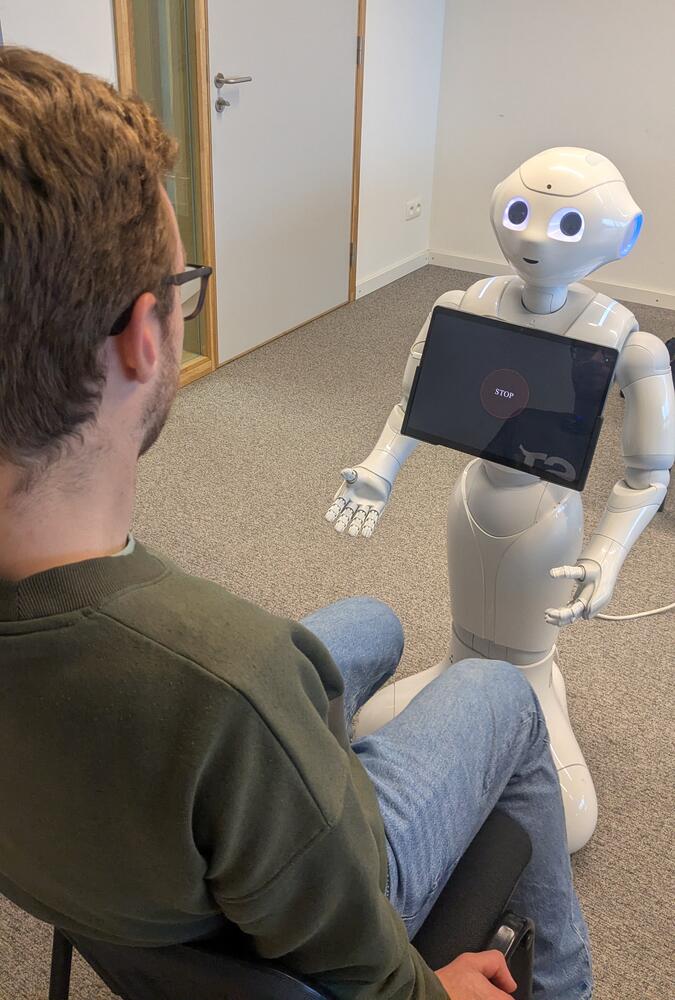
Om te onderzoeken of dat idee werkt, implementeerde ik het systeem in de humanoïde robot Pepper, die praat via het taalmodel GPT-4o. Zestien studenten voerden elk twee gesprekken van acht minuten met de robot: één met de tweede AI actief en één zonder. Het ene gesprek ging over iets positiefs, het andere over iets stressvols.
Over alle gesprekken heen vonden de deelnemers de robot met de tweede AI proactiever, ongeacht of het gesprek over een stressvol of een positief onderwerp ging. Tijdens de stressvolle gesprekken specifiek vonden ze de robot emotioneel responsiever met die tweede AI actief.
Ook in de gesprekken zelf was een verschil te zien. Wanneer een deelnemer in het stressvolle gesprek iets emotioneels vertelde, stelde de gewone robot in 6 van de 71 gevallen meerdere vragen tegelijk. Met de tweede AI actief gebeurde dat 0 keer op 82 emotioneel geladen momenten. Zoals bij het voorbeeld in het begin van dit artikel, kan zo’n dubbele vraag zwaar aanvoelen om in één beurt te beantwoorden. Het lijkt een detail, maar het zijn net zulke details die een sociaal gesprek kunnen maken of breken en bepalen of er al dan niet een band ontstaat tussen de robot en de gebruiker.
"Ik voel me echt begrepen. Het is niet dat hij gewoon antwoordt en dan verdergaat."
- een deelnemer, na het gesprek met de tweede AI
Toch vonden de deelnemers de robot met de tweede AI niet warmer, comfortabeler of aangenamer dan zonder. De tweede AI verbetert wat de robot doet op moeilijke momenten, maar verandert nog niet hoe het hele gesprek aanvoelt.
Geen vervanging voor mensen
Er bestaat dus nog geen robot die een menselijk gesprek kan vervangen.
Voor sociale robots echt ingezet kunnen worden, moeten we ook belangrijke vragen rond privacy en veiligheid beantwoorden. Wat gebeurt er bijvoorbeeld met zeer persoonlijke informatie die iemand aan een robot toevertrouwt? Wie mag die informatie bekijken? En hoe veilig wordt ze opgeslagen?
Daarnaast verzinnen taalmodellen soms informatie. Voor een kwetsbare gebruiker, zoals iemand met dementie, kan foutieve informatie extra verwarrend zijn.
Een robot hoeft dus niet volledig menselijk te worden om sociaal nuttig te zijn, maar als we technologie willen inzetten als aanvulling op menselijke zorg en contact, moet ze de sociale vaardigheden leren die een gesprek natuurlijk maken. Tegelijk moeten we goed nadenken over de gevolgen van technologie die steeds meer persoonlijke informatie van mensen verzamelt en verwerkt.
De toekomst van sociale AI ligt dus niet in robots die steeds beter leren praten, maar in robots die beter leren luisteren.
Bibliografie
[1] Vasu Agrawal et al. Seamless Interaction: Dyadic Audiovisual Motion Modeling and Large-Scale Dataset. July 1, 2025. doi: 10.48550/arXiv.2506.22554. arXiv: 2506.22554[cs]. url: http: //arxiv.org/abs/2506.22554 (visited on 12/03/2025).
[2] Johan Albrecht. Kan het preventiebeleid een zorginfarct voorkomen? Vergrijzing en multimorbiditeit zetten zorgsysteem onder grote druk. Policy Report. Itinera Institute / Ghent University, 2024. url: https://www.itinera.team/sites/default/files/content-documents/Kan%20het% 20preventiebeleid%20een%20zorginfarct%20voorkomen_0.pdf.
[3] Theo Araujo and Nadine Bol. “From speaking like a person to being personal: The effects of personalized, regular interactions with conversational agents”. In: Computers in Human Behavior: Artificial Humans 2.1 (Jan. 2024), p. 100030. issn: 29498821. doi: 10.1016/j.chbah.2023. 100030. url: https://linkinghub.elsevier.com/retrieve/pii/S2949882123000300 (visited on 11/03/2025).
[4] Minja Axelsson, Micol Spitale, and Hatice Gunes. “Robots as Mental Well-being Coaches: Design and Ethical Recommendations”. In: ACM Transactions on Human-Robot Interaction 13.2 (June 30, 2024), pp. 1–55. issn: 2573-9522. doi: 10.1145/3643457. url: https://dl.acm.org/doi/10. 1145/3643457 (visited on 04/05/2026).
[5] Yuntao Bai et al. Constitutional AI: Harmlessness from AI Feedback. Dec. 15, 2022. doi: 10.48550/ arXiv.2212.08073. arXiv: 2212.08073[cs]. url: http://arxiv.org/abs/2212.08073 (visited on 01/08/2026).
[6] Wilma A. Bainbridge et al. “The Benefits of Interactions with Physically Present Robots over Video-Displayed Agents”. In: International Journal of Social Robotics 3.1 (Jan. 2011), pp. 41–52. issn: 1875-4791, 1875-4805. doi: 10.1007/s12369-010-0082-7. url: http://link.springer. com/10.1007/s12369-010-0082-7 (visited on 05/20/2026).
[7] Christoph Bartneck et al. Human-robot interaction: an introduction. Cambridge: Cambridge uni versity press, 2020. isbn: 978-1-108-67664-9.
[8] Myl`ene Bilodeau-Mercure and Pascale Tremblay. “Age Differences in Sequential Speech Produc tion: Articulatory and Physiological Factors”. In: Journal of the American Geriatrics Society 64.11 (Nov. 2016). issn: 0002-8614, 1532-5415. doi: 10.1111/jgs.14491. url: https://agsjournals. onlinelibrary.wiley.com/doi/10.1111/jgs.14491 (visited on 05/13/2026).
[9] Kenneth A. Bollen and Richard Lennox. “Conventional wisdom on measurement: A structural equation perspective”. In: Psychological Bulletin 110.2 (1991), pp. 305–314. doi: 10.1037/0033 2909.110.2.305.
[10] Rishi Bommasani et al. “On the opportunities and risks of foundation models”. In: arXiv preprint arXiv:2108.07258 (2021).
[11] Rezvan Boostani, Cosmin Munteanu, and Anastasia Kuzminykh. “Towards Age-Inclusive Conver sational interfaces: Understanding Requirements Across Age Groups”. In: Proceedings of the 7th ACM Conference on Conversational User Interfaces. CUI ’25: Proceedings of the 7th ACM Confer ence on Conversational User Interfaces. Waterloo ON Canada: ACM, July 8, 2025, pp. 1–13. isbn: 979-8-4007-1527-3. doi: 10.1145/3719160.3736619. url: https://dl.acm.org/doi/10.1145/ 3719160.3736619 (visited on 11/03/2025).
[12] Sera Buyukgoz et al. “Exploring Behavioral Creativity of a Proactive Robot”. In: Frontiers in Robotics and AI 8 (Nov. 26, 2021), p. 694177. issn: 2296-9144. doi: 10.3389/frobt.2021.694177. url: https://pmc.ncbi.nlm.nih.gov/articles/PMC8662345/ (visited on 03/29/2026).
[13] Colleen M. Carpinella et al. “The Robotic Social Attributes Scale (RoSAS): Development and Vali dation”. In: Proceedings of the 2017 ACM/IEEE International Conference on Human-Robot Interac tion. HRI ’17: ACM/IEEE International Conference on Human-Robot Interaction. Vienna Austria: ACM, Mar. 6, 2017, pp. 254–262. isbn: 978-1-4503-4336-7. doi: 10.1145/2909824.3020208. url: https://dl.acm.org/doi/10.1145/2909824.3020208 (visited on 05/14/2026).
[14] Elior Carsenti et al. “Designing a Robot’s Proactivity: Adjusting the Robot’s Communication Modality to the Participant’s Cognitive Load”. In: Companion Proceedings of the 21st ACM/IEEE International Conference on Human-Robot Interaction. HRI Companion ’26. New York, NY, USA: Association for Computing Machinery, Mar. 16, 2026, pp. 552–557. isbn: 979-8-4007-2321-6. doi: 10.1145/3776734.3794456. url: https://dl.acm.org/doi/10.1145/3776734.3794456 (visited on 04/28/2026).
[15] Yi-Pei Chen et al. “Recent Trends in Personalized Dialogue Generation: A Review of Datasets, Methodologies, and Evaluations”. In: Proceedings of the 2024 Joint International Conference on Computational Linguistics, Language Resources and Evaluation (LREC-COLING 2024). 2024. url: https://aclanthology.org/2024.lrec-main.1192/.
[16] Yi Cheng et al. AutoPal: Autonomous Adaptation to Users for Personal AI Companionship. June 7, 2025. doi: 10.48550/arXiv.2406.13960. arXiv: 2406.13960[cs]. url: http://arxiv.org/abs/ 2406.13960 (visited on 11/03/2025).
[17] Carlos A. Cifuentes et al. “Social robots in therapy and care”. In: Current Robotics Reports 1 (2020), pp. 59–74.
[18] Chlo´e Clavel, Matthieu Labeau, and Justine Cassell. “Socio-conversational systems: Three chal lenges at the crossroads of fields”. In: Frontiers in Robotics and AI 9 (Dec. 15, 2022), p. 937825. issn: 2296-9144. doi: 10.3389/frobt.2022.937825. url: https://www.frontiersin.org/ articles/10.3389/frobt.2022.937825/full (visited on 04/05/2026). [19] I. M. Corbin and A. Dhand. “Unshared minds, decaying worlds: towards a pathology of chronic loneliness”. In: The Journal of Medicine and Philosophy: A Forum for Bioethics and Philosophy of Medicine 49 (2024), pp. 354–366.
[20] Samuel Rhys Cox, Grace Cheong, and Wei Tsang Ooi. The use of deception in dementia-care robots: Should robots tell ”white lies” to limit emotional distress? Sept. 8, 2023. doi: 10.48550/arXiv. 2309.04267. arXiv: 2309.04267[cs]. url: http://arxiv.org/abs/2309.04267 (visited on 05/09/2026).
[21] Kerstin Dautenhahn. “Socially intelligent robots: dimensions of human–robot interaction”. In: Philosophical Transactions of the Royal Society B: Biological Sciences 362.1480 (Apr. 29, 2007), pp. 679–704. issn: 0962-8436, 1471-2970. doi: 10.1098/rstb.2006.2004. url: http://royalsocietypublishing. org/rstb/article/362/1480/679-704/20947 (visited on 05/20/2026). [22] J. De Witte and T. Van Regenmortel. SILVER EMPOWERMENT- A quantitative picture of loneliness among elderly in Belgium and Europe. Tech. rep. Leuven, Belgium: HIVA- KU Leuven, 2020.
[23] Joan Dom`enech-Abella et al. “Loneliness and depression in the elderly: The role of social network”. In: Social Psychiatry and Psychiatric Epidemiology 52 (2017), pp. 381–390. [24] Eurostat. Population structure and ageing. European Commission Statistical Reports. 2025. url: https://ec.europa.eu/eurostat/statistics-explained/index.php?title=Popu… structure_and_ageing.
[25] Jesse Fox and Andrew Gambino. “Relationship Development with Humanoid Social Robots: Ap plying Interpersonal Theories to Human–Robot Interaction”. In: Cyberpsychology, Behavior, and Social Networking 24.5 (May 1, 2021), pp. 294–299. issn: 2152-2715, 2152-2723. doi: 10.1089/ cyber.2020.0181. url: https://journals.sagepub.com/doi/10.1089/cyber.2020.0181 (visited on 04/05/2026).
[26] Darren George and Paul Mallery. SPSS for Windows Step by Step: A Simple Guide and Reference, 11.0 Update. 4th. Allyn & Bacon, 2003.
[27] George Mason University. GMU HRI Scale Database. 2024. url: http://hriscaledatabase. psychology.gmu.edu/Database/ (visited on 05/13/2026).
[28] GPT-4o mini: advancing cost-efficient intelligence. OpenAI. url: https://openai.com/index/ gpt-4o-mini-advancing-cost-efficient-intelligence/ (visited on 05/09/2026).
[29] Lucrezia Grassi, Carmine Tommaso Recchiuto, and Antonio Sgorbissa. “Knowledge-Grounded Dia logue Flow Management for Social Robots and Conversational Agents”. In: International Journal of Social Robotics 14.5 (July 2022), pp. 1273–1293. issn: 1875-4791, 1875-4805. doi: 10.1007/s12369 022-00868-z. arXiv: 2108.02174[cs]. url: http://arxiv.org/abs/2108.02174 (visited on 01/08/2026).
[30] J. Guarnera, E. Yuen, and H. Macpherson. “The impact of loneliness and social isolation on cognitive aging: A narrative review”. In: Journal of Alzheimer’s Disease Reports 7 (2023), pp. 699–714.
[31] Louise C Hawkley and John T Cacioppo. “Loneliness matters: A theoretical and empirical review of consequences and mechanisms”. In: Annals of behavioral medicine 40.2 (2010), pp. 218–227.
[32] Marcel Heerink et al. “Assessing Acceptance of Assistive Social Agent Technology by Older Adults: the Almere Model”. In: International Journal of Social Robotics 2.4 (Dec. 2010), pp. 361–375. issn: 1875-4791, 1875-4805. doi: 10.1007/s12369-010-0068-5. url: http://link.springer.com/10. 1007/s12369-010-0068-5 (visited on 05/14/2026).
[33] Julianne Holt-Lunstad et al. “Loneliness and Social Isolation as Risk Factors for Mortality: A Meta Analytic Review”. In: Perspectives on Psychological Science 10.2 (Mar. 2015), pp. 227–237. issn: 1745-6916, 1745-6924. doi: 10.1177/1745691614568352. url: https://journals.sagepub.com/ doi/10.1177/1745691614568352 (visited on 05/20/2026).
[34] Aurora An-Lin Hu et al. “From Failing to Exceeding User Expectations: A Large-Scale Study Ex ploring the Role of Expectation Gap Magnitude and Direction in Robot Adoption Intention”. In: Companion Proceedings of the 21st ACM/IEEE International Conference on Human-Robot Inter action (HRI Companion ’26). Edinburgh, Scotland, UK: ACM, 2026, pp. 263–267. doi: 10.1145/ 3776734.3794395.
[35] Jie Huang et al. Large Language Models Cannot Self-Correct Reasoning Yet. Mar. 14, 2024. doi: 10.48550/arXiv.2310.01798. arXiv: 2310.01798[cs]. url: http://arxiv.org/abs/2310.01798 (visited on 04/29/2026).
[36] ITU-T. Recommendation P.800: Methods for subjective determination of transmission quality. Rec ommendation. Geneva, Switzerland: International Telecommunication Union, Aug. 1996.
[37] Ruben Janssens et al. “Online Prediction of User Enjoyment in Human-Robot Dialogue with LLMs”. In: Proceedings of the 2025 ACM/IEEE International Conference on Human-Robot In teraction (HRI). IEEE Press, 2025, pp. 1363–1367.
[38] Benjamin T. Kaveladze et al. “Social interactivity in live video experiences reduces loneliness”. In: Frontiers in Digital Health 4 (2022), p. 859849.
[39] Zoha Khawaja and Jean-Christophe B´elisle-Pipon. “Your robot therapist is not your therapist: understanding the role of AI-powered mental health chatbots”. In: Frontiers in Digital Health 5 (Nov. 8, 2023), p. 1278186. issn: 2673-253X. doi: 10.3389/fdgth.2023.1278186. url: https:// www.frontiersin.org/articles/10.3389/fdgth.2023.1278186/full (visited on 05/09/2026). [40] Callie Y. Kim, Christine P. Lee, and Bilge Mutlu. “Understanding large-language model (llm) powered human-robot interaction”. In: Proceedings of the 2024 ACM/IEEE International Confer ence on Human-Robot Interaction (HRI). New York, NY, USA: ACM, 2024, pp. 371–380.
[41] Filipa Landeiro et al. “Reducing social isolation and loneliness in older people: a systematic review protocol”. In: BMJ Open 7.5 (2017), e013778. doi: 10.1136/bmjopen-2016-013778.
[42] Dong Won Lee et al. The Human Robot Social Interaction (HSRI) Dataset: Benchmarking Foun dational Models’ Social Reasoning. Apr. 7, 2025. doi: 10.48550/arXiv.2504.13898. arXiv: 2504.13898[cs]. url: http://arxiv.org/abs/2504.13898 (visited on 12/03/2025).
[43] S´everin Lemaignan et al. “Artificial cognition for social human–robot interaction: An implemen tation”. In: Artificial Intelligence 247 (June 2017), pp. 45–69. issn: 00043702. doi: 10.1016/j. artint.2016.07.002. url: https://linkinghub.elsevier.com/retrieve/pii/S0004370216300790 (visited on 01/08/2026).
[44] Pengfei Liu et al. “Pre-train, prompt, and predict: A systematic survey of prompting methods in natural language processing”. In: ACM Computing Surveys 55.9 (2023), pp. 1–35.
[45] LLM as a Judge. Arize AI. url: https://arize.com/llm-as-a-judge/ (visited on 04/28/2026).
[46] Wing-YueGeoffrey Louie et al. “A focus group study on the design considerations and impressions of a socially assistive robot for long-term care”. In: The 23rd IEEE International Symposium on Robot and Human Interactive Communication. 2014 RO-MAN: The 23rd IEEE International Symposium on Robot and Human Interactive Communication. Edinburgh, UK: IEEE, Aug. 2014, pp. 237 242. isbn: 978-1-4799-6765-0 978-1-4799-6763-6. doi: 10.1109/ROMAN.2014.6926259. url: http: //ieeexplore.ieee.org/document/6926259/ (visited on 04/05/2026).
[47] Yong Ma et al. “Beyond Words: Measuring User Experience through Speech Analysis in Voice User Interfaces”. In: Proceedings of the CHI Conference on Human Factors in Computing Systems (CHI ’26). arXiv:2603.19904. 2026. doi: 10.1145/3772318.3791747.
[48] Ester Martinez-Martin and Angel P. del Pobil. “Personal robot assistants for elderly care: an overview”. In: Personal assistants: Emerging computational technologies. Springer, 2017, pp. 77–91.
[49] Brent Daniel Mittelstadt and Luciano Floridi. “The Ethics of Big Data: Current and Foreseeable Issues in Biomedical Contexts”. In: Science and Engineering Ethics 22.2 (2016), pp. 303–341. doi: 10.1007/s11948-015-9652-2.
[50] E. Morgante et al. “Is it possible for people to develop a sense of empathy toward humanoid robots and establish meaningful relationships with them?” In: Frontiers in Psychology 15 (2024), p. 1391832.
[51] Alice Nardelli, Antonio Sgorbissa, and Carmine Tommaso Recchiuto. Designing Empathetic Com panions: Exploring Personality, Emotion, and Trust in Social Robots. Apr. 17, 2025. doi: 10.48550/ arXiv.2504.13964. arXiv: 2504.13964[cs]. url: http://arxiv.org/abs/2504.13964 (visited on 04/05/2026).
[52] B´erang`ere Naud´e, Anne-Sophie Rigaud, and Maribel Pino. “Video Calls for Older Adults: A Nar rative Review of Experiments Involving Older Adults in Elderly Care Institutions”. In: Frontiers in Public Health 9 (2022), p. 751150. doi: 10.3389/fpubh.2021.751150.
[53] NevaMind-AI/memU. 2025-07-29. Apr. 28, 2026. url: https://github.com/NevaMind-AI/memU (visited on 04/28/2026).
[54] Samuel A. Olatunji et al. “Considerations for designing socially assistive robots for older adults”. In: Frontiers in Robotics and AI 12 (Oct. 16, 2025), p. 1622206. issn: 2296-9144. doi: 10.3389/ frobt.2025.1622206. url: https://www.frontiersin.org/articles/10.3389/frobt.2025. 1622206/full (visited on 05/13/2026).
[55] Lucy Osler. “Hallucinating with AI: Distributed Delusions and “AI Psychosis””. In: Philosophy & Technology (2026). doi: 10.1007/s13347-026-01034-3.
[56] Maike Paetzel-Pr¨usmann et al. “An Automatic Evaluation Framework for Social Conversations with Robots”. In: Proceedings of the 2024 International Symposium on Technological Advances in Human-Robot Interaction. TAHRI 2024: 2024 International Symposium on Technological Advances in Human-Robot Interaction. Boulder CO USA: ACM, Mar. 9, 2024, pp. 56–64. isbn: 979-8-4007 1661-4. doi: 10.1145/3648536.3648543. url: https://dl.acm.org/doi/10.1145/3648536. 3648543 (visited on 01/08/2026).
[57] Amit Kumar Pandey and Rodolphe Gelin. “A Mass-Produced Sociable Humanoid Robot: Pepper: The First Machine of Its Kind”. In: IEEE Robotics & Automation Magazine 25.3 (2018), pp. 40–48. doi: 10.1109/MRA.2018.2833157.
[58] Richard Yuanzhe Pang et al. Leveraging Implicit Feedback from Deployment Data in Dialogue. Feb. 1, 2024. doi: 10.48550/arXiv.2307.14117. arXiv: 2307.14117[cs]. url: http://arxiv. org/abs/2307.14117 (visited on 05/09/2026).
[59] Sung Park and Mincheol Whang. “Empathy in Human–Robot Interaction: Designing for Social Robots”. In: International Journal of Environmental Research and Public Health 19.3 (Feb. 8, 2022), p. 1889. issn: 1660-4601. doi: 10.3390/ijerph19031889. url: https://www.mdpi.com/1660 4601/19/3/1889 (visited on 04/05/2026).
[60] Maria J. Pinto and Tony Belpaeme. “Predictive Turn-Taking: Leveraging Language Models to An ticipate Turn Transitions in Human-Robot Dialogue”. In: 2024 33rd IEEE International Confer ence on Robot and Human Interactive Communication (RO-MAN). IEEE, Aug. 2024. url: https: //ieeexplore.ieee.org/document/10731379/.
[61] Maria J. Pinto-Bernal, Kato Boels, and Tony Belpaeme. “Fostering Social Connection and Emo tional Engagement to Mitigate Social Isolation in Care Homes Using Empathetic Human-Robot Conversation”. Preprint via Research Square. 2024. url: https://doi.org/10.21203/rs.3.rs 6811088/v1.
[62] Robert D. Putnam. Bowling alone: The collapse and revival of American community. Simon and Schuster, 2000.
[63] Yifu Qiu et al. Are Large Language Models Temporally Grounded? Nov. 16, 2023. doi: 10.48550/ arXiv.2311.08398. arXiv: 2311.08398[cs.CL]. url: http://arxiv.org/abs/2311.08398 (visited on 05/12/2026).
[64] Anne-Sophie Rigaud et al. “Implementation of socially assistive robots in geriatric care institutions: Healthcare professionals’ perspectives and identification of facilitating factors and barriers”. In: Journal of Rehabilitation and Assistive Technologies Engineering 11 (Aug. 2024), p. 20556683241284765. issn: 2055-6683, 2055-6683. doi: 10.1177/20556683241284765. url: https://journals.sagepub. com/doi/10.1177/20556683241284765 (visited on 05/09/2026).
[65] Laura Saad et al. “Choosing the “Perfect” Scale: A Primer to Evaluate Existing Scales in HRI”. In: ACM Transactions on Human-Robot Interaction 15.2 (Mar. 31, 2026), pp. 1–30. issn: 2573 9522. doi: 10.1145/3772066. url: https://dl.acm.org/doi/10.1145/3772066 (visited on 05/14/2026).
[66] Matthias Schmidmaier et al. “Perceived Empathy of Technology Scale (PETS): Measuring Empa thy of Systems Toward the User”. In: Proceedings of the CHI Conference on Human Factors in Computing Systems. CHI ’24: CHI Conference on Human Factors in Computing Systems. Honolulu HI USA: ACM, May 11, 2024, pp. 1–18. isbn: 979-8-4007-0330-0. doi: 10.1145/3613904.3642035. url: https://dl.acm.org/doi/10.1145/3613904.3642035 (visited on 05/14/2026).
[67] Amanda Sharkey and Noel Sharkey. “Granny and the robots: ethical issues in robot care for the elderly”. In: Ethics and Information Technology 14.1 (Mar. 2012), pp. 27–40. issn: 1388-1957, 1572 8439. doi: 10.1007/s10676-010-9234-6. url: http://link.springer.com/10.1007/s10676 010-9234-6 (visited on 05/20/2026).
[68] Chapa Sirithunge, A. G. Buddhika P. Jayasekara, and D. P. Chandima. “An Evaluation of Human Conversational Preferences in Social Human-Robot Interaction”. In: Applied Bionics and Biome chanics 2021 (Feb. 22, 2021). Ed. by Francesca Cordella, pp. 1–13. issn: 1754-2103, 1176-2322. doi: 10.1155/2021/3648479. url: https://www.hindawi.com/journals/abb/2021/3648479/ (visited on 04/05/2026).
[69] Gabriel Skantze. “Turn-taking in Conversational Systems and Human-Robot Interaction: A Re view”. In: Computer Speech & Language 67 (2021), p. 101178. doi: 10.1016/j.csl.2020.101178.
[70] Gabriel Skantze and Bahar Irfan. “Applying General Turn-taking Models to Conversational Human Robot Interaction”. In: Proceedings of the 2025 ACM/IEEE International Conference on Human Robot Interaction (HRI). IEEE, 2025, pp. 859–868.
[71] Yenee Soh et al. “Chronic loneliness and the risk of incident stroke in middle and late adulthood: a longitudinal cohort study of U.S. older adults”. In: EClinicalMedicine 73 (2024), p. 102639. doi: 10.1016/j.eclinm.2024.102639.
[72] Carson Stark et al. “Dobby: a conversational service robot driven by gpt-4”. In: 2024 33rd IEEE In ternational Conference on Robot and Human Interactive Communication (RO-MAN). IEEE, 2024, pp. 1362–1369.
[73] Richard Sutcliffe. A Survey of Personality, Persona, and Profile in Conversational Agents and Chatbots. Dec. 31, 2023. doi: 10.48550/arXiv.2401.00609. arXiv: 2401.00609[cs]. url: http: //arxiv.org/abs/2401.00609 (visited on 11/03/2025).
[74] A. R. Sutin et al. “Loneliness and risk of dementia”. In: The Journals of Gerontology: Series B 75 (2020), pp. 1414–1422.
[75] TEN Ecosystem. TEN Framework Documentation: Vision. Agora. 2024. url: https://theten. ai/docs#vision (visited on 05/13/2026).
[76] Vera Toepoel. “Ageing, leisure, and social connectedness: How could leisure help reduce social isolation of older people?” In: Social Indicators Research 113.1 (2013), pp. 355–372. [77] United Nations, Department of Economic and Social Affairs, Population Division. World Population Ageing 2019. ST/ESA/SER.A/444. New York: United Nations, 2019.
[78] Joshua Wainer et al. “The Role of Physical Embodiment in Human-Robot Interaction”. In: RO MAN 2006- 15th IEEE International Symposium on Robot and Human Interactive Communication. IEEE, Sept. 2006, pp. 117–122. doi: 10.1109/ROMAN.2006.314404. url: https://ieeexplore. ieee.org/document/4107795 (visited on 05/26/2026).
[79] Fan Wang et al. Social Robots for People Living with Dementia: A Scoping Review on Deception from Design to Perception. Mar. 14, 2026. doi: 10.48550/arXiv.2507.00963. arXiv: 2507. 00963[cs.HC]. url: http://arxiv.org/abs/2507.00963 (visited on 05/20/2026).
[80] Aimee-Rose Wrightson-Hester et al. “A Rule-Based Conversational Agent for Mental Health and Well-Being in Young People: Formative Case Series During the Rise of Generative AI”. In: JMIR Formative Research 9 (Dec. 1, 2025), e69841. issn: 2561-326X. doi: 10.2196/69841. url: https: //formative.jmir.org/2025/1/e69841 (visited on 05/09/2026).
[81] S. Zamir et al. “Video-calls to reduce loneliness and social isolation within care environments for older people: an implementation study using collaborative action research”. In: BMC geriatrics 18 (2018), pp. 1–13.
[82] Saizheng Zhang et al. Personalizing Dialogue Agents: I have a dog, do you have pets too? Sept. 25, 2018. doi: 10.48550/arXiv.1801.07243. arXiv: 1801.07243[cs]. url: http://arxiv.org/abs/ 1801.07243 (visited on 11/03/2025).
[83] Zhehao Zhang et al. Personalization of Large Language Models: A Survey. July 13, 2025. doi: 10.48550/arXiv.2411.00027. arXiv: 2411.00027[cs]. url: http://arxiv.org/abs/2411.00027 (visited on 11/03/2025).
[84] Wayne Xin Zhao et al. “A survey of large language models”. In: arXiv preprint arXiv:2303.18223 (2023).
[85] Lianmin Zheng et al. “Judging LLM-as-a-judge with MT-Bench and Chatbot Arena”. In: Advances in Neural Information Processing Systems. Vol. 36. 2023, pp. 46595–46617.
[86] Xing Zhou et al. MemTrust: A Zero-Trust Architecture for Unified AI Memory System. Jan. 11, 2026. doi: 10.48550/arXiv.2601.07004. arXiv: 2601.07004[cs.CR]. url: http://arxiv.org/ abs/2601.07004 (visited on 05/20/2026)





