

Zeewier in je moestuin
Sla, komkommer, tomaten … je kweekt ze zo in je serre of moestuin. Maar heb je ooit al eens aan zeewier gedacht? Voor veel mensen is zeewier dat glibberige bruine spul dat tussen je tenen blijft hangen als je in zee stapt. En ja, dat is inderdaad zeewier. Maar zeewier is ook zoveel meer.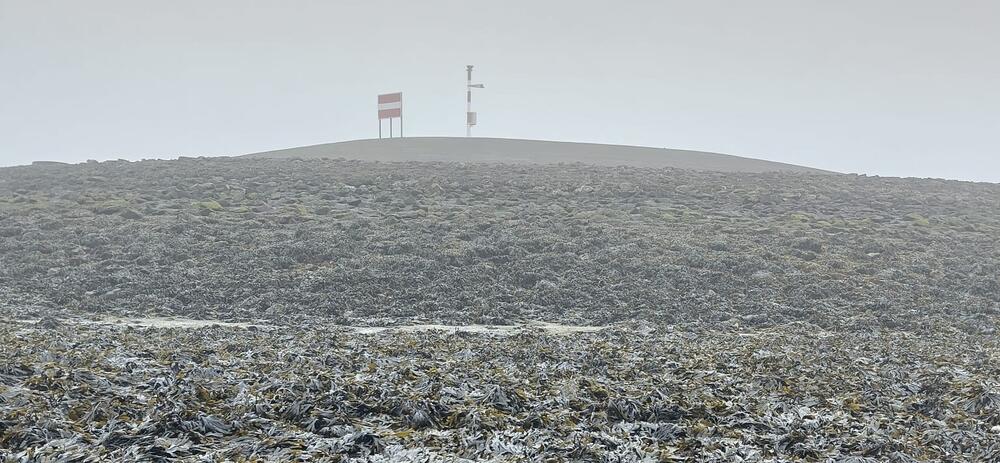
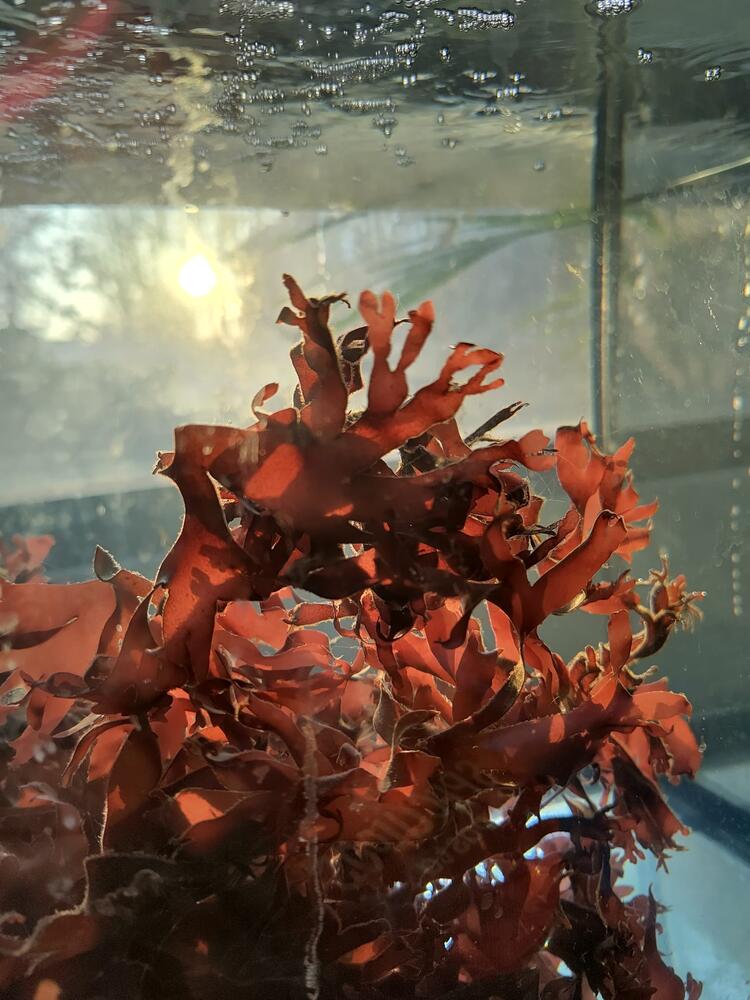
Zeewier zit namelijk boordevol essentiële aminozuren. Dit zijn de bouwstenen van eiwitten die ons lichaam nodig heeft voor onder andere het opbouwen van spieren en het aanmaken van DNA. Vaak halen we deze bouwstenen uit vlees, maar dat legt een zware druk op onze planeet. Goed nieuws: diezelfde belangrijke voedingsstoffen vind je óók in zeewier, en dat op een verrassend duurzame manier.

En nu komt het leukste: je kan deze groene, rode of bruine superhelden gewoon zelf kweken! Stel je voor: naast je tomaten en courgettes kan je straks een mini‑zee vol voedzame, milieuvriendelijke plantjes kweken. Zeewier als nieuwe ster in je moestuin? Waarom eigenlijk niet?
Zeewier kweken doe je niet zomaar: het groeit nu eenmaal niet op het land maar in het water. Maar moet je daarvoor een olympisch zwembad uitgraven? Gelukkig niet. Onder de juiste omstandigheden groeit zeewier perfect in een aquarium, een grote bokaal of zelfs een simpele doorzichtige pot.
Zijn wij in de toekomst? Nee! Wat zout water, een stabiele temperatuur, voldoende licht en een portie geduld, en voor je het weet heb je een (t)huisje voor je zeewier.
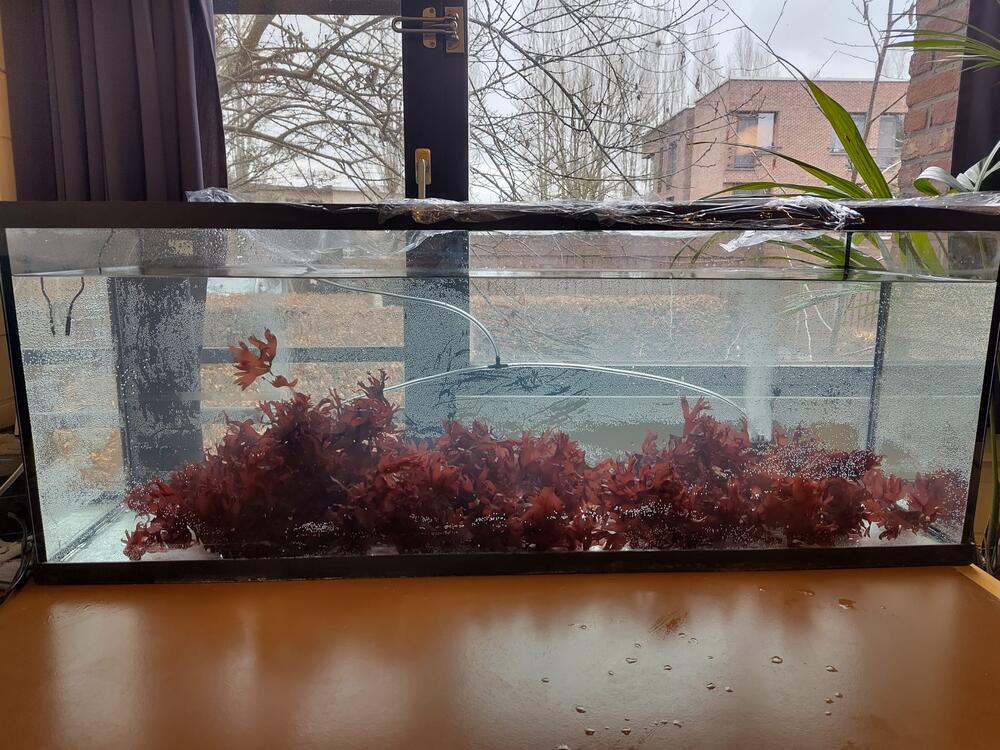
Heb je nog materiaal liggen van die vis die je kinderen absoluut moesten hebben (en die jij uiteindelijk verzorgde)? Dan heb je al een ideale basis voor je mini‑zeewierboerderij. Een pompje, wat verlichting, een bak die water kan houden… meer heb je niet nodig om je eigen kleine zee‑ecosysteem te starten.
Addertje onder het zeewier
Of dit sprookje echt zo moeiteloos is als het klinkt? Dat valt nog te bezien. Net zoals bij elke teelt vraagt ook zeewier tijd, aandacht en vooral… herhaling. Het lijkt misschien simpel, een pot water, wat licht, een snufje zout, maar zeewier is verrassend kieskeurig.
Vergelijk het met jezelf: jij hebt ook een favoriete dikte van deken, een ideale kamertemperatuur en een perfecte plek om te slapen. Zeewier is net hetzelfde. Het wil precies de juiste omstandigheden: het juiste zoutgehalte, voldoende licht, een stabiele temperatuur en een constante waterkwaliteit. Dat blijkt helaas niet altijd zo makkelijk te zijn. Welke zeewiersoorten zich wel makkelijk thuis voelen in onze woning of hoe hun ideale plekje eruit ziet op onze vensterbank is nog niet gekend. Daar zullen wetenschappers maar ook gepassioneerde tuinierders verder op zoeken moeten achter gaan.
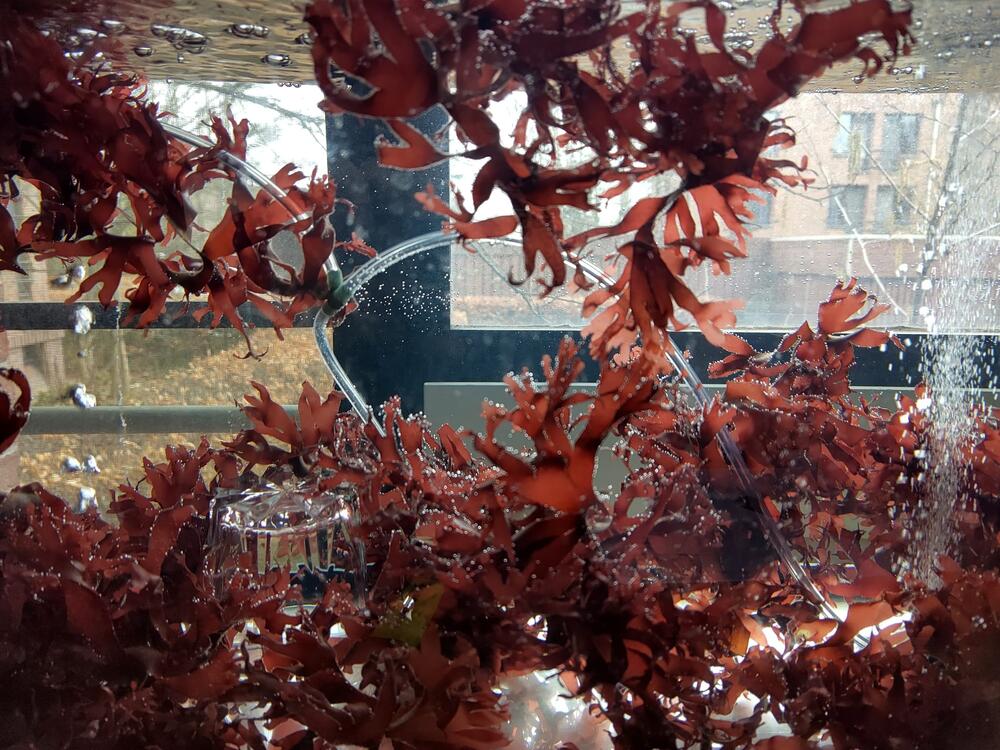
Gelukkig wilt deze onwetendheid niet zeggen dat je die aquarium en luchtpomp terug moet opbergen. Het kweken van zeewier blijkt een leuke bijkomende hobby te zijn. Of zoek je nog een gespreksonderwerp voor een eerste date? Misschien kan zeewier dan wat opties bieden. Het blijkt namelijk de start te zijn van open, educatieve en inspirerende gesprekken over ons hedendaagse en mogelijks toekomstige voedselsysteem.
Je weet wat ze zeggen: de aanhouder wint!
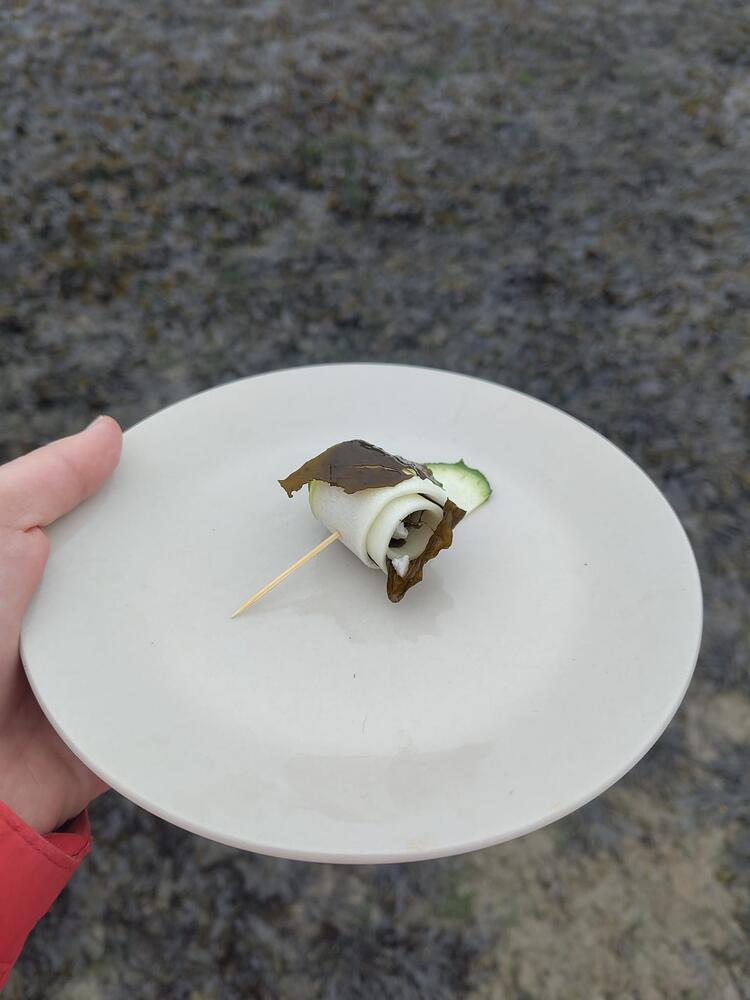
Voor de doorzetters onder ons lonkt aan het einde van de tunnel een verrassend lekkere traktatie. Want als je erin slaagt je zeewier helemaal in zijn nopjes te krijgen, dan beloont het je met iets bijzonders: smaak.
Van knapperige chips tot hartige soep, van romige puree tot frisse salade. Zeewier laat zich verwerken in meer gerechten dan je zou denken. En dat maakt het misschien wel het mooiste aan heel dit avontuur.

Gaan deze kleine plantjes een grootste toekomst tegemoet? Wie weet staat er binnenkort in elke keuken een glazen pot met zacht wiegend zeewier. Misschien wordt het nooit zo simpel als een tomatenplant. In de tussentijd blijft zeewier dat glibberige bruine spul, en toch ook zoveel meer...
Bibliografie
A Fricke , E. Capuzzo, R. Bermejo, Lc. Hofmann, I. Hernández, R. Pereira, Swk. Van den Burg, T.
Pereira, Ah. Buschmann, & Ej. Cottier-Cook. (2024). Ecosystem Services Provided by
Seaweed Cultivation: State of the Art, Knowledge Gaps, Constraints and Future Needs
for Achieving Maximum Potential in Europe. Reviews in Fisheries Science & Aquaculture,
33(2), 238–256. https://doi.org/10.1080/23308249.2024.2399355
Adeoye‐Olatunde, O. A., & Olenik, N. L. (2021). Research and scholarly methods: Semi
structured interviews. Jaccp: Journal of the American College of Clinical Pharmacy,
4(10), 1358–1367. https://doi.org/10.1002/jac5.1441
Albert Heijn. (2026a). AH Vershoudfolie. Retrieved 14/05/2026 from
https://www.ah.nl/producten/product/wi213912/ah-vershoudfolie
Albert Heijn. (2026b). AH Keukenpapier sterk & abs 2=3 rollen. Retrieved 14/05/2026 from
https://www.ah.nl/producten/product/wi584125/ah-keukenpapier-sterk-en-a…
2%3D3-rollen
Algae research and supply. (n.d.). f/2 Media. Retrieved 06/04/2026 from
https://algaeresearchsupply.com/pages/f-2-media
Arakaki, N., Flores Ramos, L., Oscanoa Huaynate, A. I., Ruíz Soto, A., & Ramírez, M. E. (2023).
Biochemical and nutritional characterization of edible seaweeds from the Peruvian
coast. Plants, 12(9), 1795.
ASC. (n.d.). Learn more about seaweed. Retrieved 25/05/2026 from https://asc-aqua.org/learn
about-seafood-farming/farmed-seaweed/
Banach, J. L., Hoek-va, d., Hil, E. F. , & van der Fels-Klerx, H. J. (2020). Food safety hazards in the
European seaweed chain. COMPREHENSIVE REVIEWS IN FOOD SCIENCE AND FOOD
SAFETY.
Bio Base Europe Pilot Plant. (n.d.). SUPROSEA. Retrieved 18/04/2026 from
https://www.bbeu.org/projects/suprosea/
Bol.com. (2026a). Aquariums van 100 tot 200 liter. Retrieved 14/05/2026 from
https://www.bol.com/be/nl/l/aquariums-van-100-tot-200-liter/21836/32066…;
Bol.com. (2026b). As instant ocean zout 300 l/10 kg | Aquarium Zout. Retrieved 14/05/2026 from
https://www.bol.com/be/nl/p/as-instant-ocean-zout-300-l-10-kg-aquarium
zout/9300000112655234/
Bol.com. (2026c). Eheim Air 100 Luchtpomp - Regelbaar. Retrieved 14/05/2026 from
https://www.bol.com/be/nl/p/eheim-luchtpomp-regelbaar-3701-100-l-h-met-…
slang-1-uit/9200000055656011/
Bol.com. (2026d). WiseGoods Aquarium Thermometer - Analoge Watertemperatuurmeter met
Zuignap - Thermometer Glas 0-40 Graden Celsius. Retrieved 14/05/2026 from
https://www.bol.com/be/nl/p/wisegoods-aquarium-thermometer-analoge
watertemperatuurmeter-met-zuignap-thermometer-glas-0-40-graden
celsius/9300000001836319/?cid=1778767172755-5532637948017&bltgh=c1d2b746
549a-4b26-9c4d-4a2e1bbf3c0c.ProductList_Middle.0.ProductTitle
Bol.com. (2026e). Keukenweegschaal Digitaal Oplaadbaar - Precisie Weegschaal Keuken Zwart
USB Zonder Batterijen - Food Kitchen Scale - Grammen Eet Kookweegschaal. Retrieved
14/05/2026 from https://www.bol.com/be/nl/p/keukenweegschaal-oplaadbaar
10kg/9300000149197814/?cid=1778767382237-4153021472447&bltgh=668cf10e
841f-48f0-a360-2d0bb123b224.ProductList_Middle.5.ProductTitle
Bol.com. (2026f). Refractometer. Retrieved 14/05/2026 from
https://www.bol.com/be/nl/p/refractometer/9200000120804361/
Boothbay Sea and Science Center. (n.d.). Exploring the Science of Seaweed Farming. Retrieved
09/05/2026 from https://boothbayseaandsciencecenter.org/exploring-the-science-of
seaweed-farming/
Vints L.
49
Cultivating seaweed at home: benefits and limitations
2025-2026
Campbell, I., & Macleod, A. (2019). The Environmental Risks Associated With the Development
of Seaweed Farming in Europe - Prioritizing Key Knowledge Gaps. Frontiers in Marine
Science.
Cherry, P., O'Hara, C., Magee, P. J., McSorley, E. M., & Allsopp, P. J. (2019). Risks and benefits of
consuming edible seaweeds. Nutr Rev, 77(5), 307–329.
https://doi.org/10.1093/nutrit/nuy066
Cleveland Clinic. (2021). Amino Acids. Retrieved 4/4/2026 from
https://my.clevelandclinic.org/health/articles/22243-amino-acids
DAVID GRIGG, S., U.K. (1995). The Pattern of World Protein
Consumption. Geoforum, 26(1), 1–17. https://doi.org/0016-7185(94)00020-4
Dębicka, O., Dalibozhko, A., Krakovetskaya, I., Rogula-Kozłowska, W., & Rogula-Kopiec, P.
(2018). Youth entrepreneurial projects for the sustainable development of global
community: evidence from Enactus program. SHS Web of Conferences, 57.
https://doi.org/10.1051/shsconf/20185701009
Departement Landbouw en Visserij. (2021). Vlaamse eiwitstrategie 2021-2030. Lokale,
duurzame en gezonde eiwitten van productie tot consumptie. Samen kansen creëren
voor welvaart, milieu en gezondheid. Retrieved 19/03/2026 from
https://www.vlaanderen.be/publicaties/vlaamse-eiwitstrategie-2021-2030-…
duurzame-en-gezonde-eiwitten-van-productie-tot-consumptie-samen-kansen-creeren
voor-welvaart-milieu-en-gezondheid
Departement Omgeving. (n.d.). Wat is een eiwitshift? Retrieved 27/03/2026 from
https://omgeving.vlaanderen.be/nl/green-deal-eiwitshift-op-ons-bord-010…
eiwitshift
Development, W. C. o. E. a. (1987). Our Common Future.
Dinesh Kumar, S., Satish, L., Dhanya, N., Malar Vizhi, J., Nadukkattu Nayagi, N., Gopala
Krishnan, S., & Ganesan, M. (2023). Tank cultivation of edible seaweeds: an overview of
the Indian perspective for opportunities and challenges. Biomass Conversion and
Biorefinery, 14(11), 11757–11767. https://doi.org/10.1007/s13399-022-03729-x
Directorate-General for Maritime Affairs and Fisheries. (2025). Algae: new Commission study
explores their bright future. Retrieved 18.04.2026 from https://oceans-and
fisheries.ec.europa.eu/news/algae-new-commission-study-explores-their-bright-future
2025-09-08_en
Easy-life. (n.d.). GreenScape. Retrieved 06/04/2026 from
https://www.easylife.nl/producten/zoetwater/plantenvoeding/greenscape&n…;
Eheim. (n.d.). EHEIM air100. Retrieved 14/05/2026 from
https://eheim.com/en_GB/aquatics/technology/air-pumps/air/air100
Eneco. (2025). Hoeveel kost 1 kWh elektriciteit en gas gemiddeld? Retrieved 14/05/2026 from
https://eneco.be/nl/inspiratie/hoeveel-kost-1-kwh-elektriciteit-en-gas-…;
FAO. (2025). Seaweed. https://openknowledge.fao.org/server/api/core/bitstreams/aa6d8412
8825-46e2-b52c-bcf6fb952c83/content
Fehlenberg, V., Baumann, M., Gasparri, N. I., Piquer-Rodriguez, M., Gavier-Pizarro, G., &
Kuemmerle, T. (2017). The role of soybean production as an underlying driver of
deforestation in the South American Chaco. Global Environmental Change, 45, 24–34.
https://doi.org/10.1016/j.gloenvcha.2017.05.001
Fleurence, J., Morançais, M., & Dumay, J. (2018). Seaweed proteins. In Proteins in food
processing (pp. 245–262). Elsevier.
Food and Agriculture Organization of the United Nations. (2023). Pathways towards lower
emissions A global assessment of the greenhouse gas emissions and mitigation options
from livestock agrifood systems. 77.
Gibbs, D. (2011). How To Grow Seaweed At Home. Retrieved 09/05/2026 from
https://www.hunker.com/12003018/how-to-grow-seaweed-at-home/
Vints L.
50
Cultivating seaweed at home: benefits and limitations
2025-2026
Guiry, M. (2004). Acrochaetium secundatum (Lyngbye) Nägeli. Retrieved 18/04/2026 from
https://www.algaebase.org/search/images/detail/?img_id=8439
Hafting, J. T., & Critchley, A. T. (2012). On-land cultivation of functional seaweed products for
human usage. Journal of Applied Phycology, 385–392.
Hortimare. (n.d.). Home. Retrieved 13/05/2026 from https://hortimare.com/
Jang, H., Lee, J., Park, Y.-K., & Lee, J.-Y. (2024). Exploring the health benefits and concerns of
brown seaweed consumption: A comprehensive review of bioactive compounds in
brown seaweed and its potential therapeutic effects. Journal of Agriculture and Food
Research, 17, 101215.
KBouwmat. (2026). Home. Retrieved 15/05/2026 from https://kbouwmat.be/
Khan, N., Sudhakar, K., & Mamat, R. (2024). Macroalgae farming for sustainable future:
Navigating opportunities and driving innovation. Heliyon, 10(7), e28208.
https://doi.org/https://doi.org/10.1016/j.heliyon.2024.e28208
Klenert, D., Funke, F., & Cai, M. (2023). Meat taxes in Europe can be designed to avoid
overburdening low-income consumers. Nature Food, 4(10), 894–901.
Knight, C. (2023). What is a triple bottom line? https://www.eib.org/en/stories/triple-bottom
line
environment#:~:text=Triple%20bottom%20line%20refers%20to,does%20not%20hurt%
20our%20future.
Lucić, R., Raposo, M., Chervinska, A., Domingos, T., & Teixeira, R. F. (2025). Global greenhouse
gas emissions and land use impacts of soybean production: systematic review and
analysis. Sustainability, 17(8), 3396.
Nilsson, J., & Martin, M. (2022). Exploratory environmental assessment of large-scale cultivation
of seaweed used to reduce enteric methane emissions. Sustainable Production and
Consumption, 30, 413–423. https://doi.org/https://doi.org/10.1016/j.spc.2021.12.006
Popieul, N. (2014). Zeewier, de toekomst. Zorro uitgeverij.
Preethi, M. (2025). Turn Your Aquarium Into a Seaweed Farm: Simple Steps To Grow Greens at
Home. Retrieved 09/05/2026 from https://thebetterindia.com/401473/grow-seaweed
at-home-guide-farming-urban/
Rath, S., Sahoo, S. S., Samantaray, A., Parhi, P., Sahoo, C. R., & Thatoi, H. (2025). Commercial
importance of seaweeds: an overview. Bioresour Bioprocess, 12(1), 119.
https://doi.org/DOI10.1186/s40643-025-00944-y
Relaes, J. (2022). Een veerkrachtig voedingssysteem voor Vlaanderen.
Rijtak. (n.d.). Microalgen, het supplement op maat van uw levensstijl. Retrieved 13/05/2026
from https://rijtak.be/
Rolin, C., Inkster, R., Laing, J., Hedges, J., & McEvoy, L. (2014). Seaweed cultivation manual.
Shetland Seaweed Growers Project, 16.
S. K. Laha, M. S. D. (2022). SEAWEED – CLASSIFICATION, SOURCE AND USES. Agri-India
TODAY, 2(5).
Seaweednetwork. (n.d.). Here’s How to Grow Seaweed in Your Own Home. Retrieved
09/05/2026 from https://seaweednetwork.id/here-s-how-to-grow-seaweed-in-your
own-home
Shafie, M. H., Kamal, M. L., Zulkiflee, F. F., Hasan, S., Uyup, N. H., Abdullah, S., Hussin, N. A. M.,
Tan, Y. C., & Zafarina, Z. (2022). Application of Carrageenan extract from red seaweed
(Rhodophyta) in cosmetic products: A review. Journal of the Indian Chemical Society,
99(9), 100613.
Spaans, G., Keur, M., Foekema, E., Muizelaar, W., Nauta, R., Niermans, K., & Banach, J. (2025).
Seaweed grown on low-value residual streams and its potential use in a safe circular
food system. Applied Food Research, 5(1), 100985.
Springmann, M., Clark, M., Mason-D'Croz, D., Wiebe, K., Bodirsky, B. L., Lassaletta, L., de Vries,
W., Vermeulen, S. J., Herrero, M., Carlson, K. M., Jonell, M., Troell, M., DeClerck, F.,
Vints L.
51
Cultivating seaweed at home: benefits and limitations
2025-2026
Gordon, L. J., Zurayk, R., Scarborough, P., Rayner, M., Loken, B., Fanzo, J.,…Willett, W.
(2018). Options for keeping the food system within environmental limits. Nature,
562(7728), 519–525. https://doi.org/10.1038/s41586-018-0594-0
Stévant, P., Schmedes, P. S., Le Gall, L., Wegeberg, S., Dumay, J., & Rebours, C. (2023). Concise
review of the red macroalga dulse, Palmaria palmata (L.) Weber & Mohr. Journal of
Applied Phycology, 35(2), 523–550.
Tan, H. X., Yeo, Z., Ng, R., Tjandra, T. B., & Song, B. (2015). A Sustainability Indicator Framework
for Singapore Small and Medium-Sized Manufacturing Enterprises. Procedia CIRP, 29,
132–137. https://doi.org/10.1016/j.procir.2015.01.028
Tenorio-Rodríguez, P. A., Nicasio-Arzeta, S., Robledo, D., & Freile-Pelegrín, Y. (2025). Consumer
acceptance of edible seaweed in Mexico: An exploratory study on willingness. Food
Quality and Preference, 133. https://doi.org/doi.org/10.1016/j.foodqual.2025.105630
Titlyanov, E. A., & Titlyanova, T. V. (2010). Seaweed cultivation: Methods and problems. Russian
Journal of Marine Biology, 36(4), 227–242. https://doi.org/10.1134/S1063074010040012
Tullberg, R. M., Nguyen, H. P., & Wang, C. M. (2022). Review of the Status and Developments in
Seaweed Farming Infrastructure. Journal of Marine Science and Engineering.
Umanzor, S., Ladah, L., Calderon-Aguilera, L. E., & Zertuche-González, J. A. (2019). Testing the
relative importance of intertidal seaweeds as ecosystem engineers across tidal heights.
Journal of Experimental Marine Biology and Ecology, 511, 100–107.
https://doi.org/10.1016/j.jembe.2018.11.008
van den Burg, S. W. K., Dagevos, H., Helmes, R. J. K., & Pernet, F. (2021). Towards sustainable
European seaweed value chains: a triple P perspective. ICES Journal of Marine Science,
78(1), 443–450. https://doi.org/10.1093/icesjms/fsz183
Vieira, E. F., Soares, C., Machado, S., Correia, M., Ramalhosa, M. J., Oliva-Teles, M. T., Carvalho,
A. P., Domingues, V. F., Antunes, F., & Oliveira, T. A. C. (2018). Seaweeds from the
Portuguese coast as a source of proteinaceous material: Total and free amino acid
composition profile. Food Chemistry, 269, 264–275.
Vlaamse Milieumaatschappij. (n.d.). De prijs van water. Retrieved 25/04/2026 from
https://vmm.vlaanderen.be/waterloket/de-waterfactuur/de-prijs-van-water…;
Vlaanderen Huisdierinfo. (n.d.). Zoutwateraquarium (zeeaquarium): aankoop, opstarten en
onderhouden. Retrieved 04/04/2026 from
https://www.vlaanderen.be/huisdierinfo/verzorging-van-huisdieren/terrar…
en-inrichting/zoutwateraquarium-zeeaquarium-aankoop-opstarten-en
onderhouden#opstart-van-een-zeewateraquarium
Volkova, S. K. (n.d.). How to Grow Edible Seaweed at Home: Indoor Kelp Farming Made Simple.
Retrieved 09/05/2026 from https://seaweeding.com/how-do-i-grow-algae-and
seaweed/
Werner, A. (2011). Aquaculture explained: Cultivating Palmaria palmata. BIM, 27, 76.
WHO. (2026). Healthy diet. Retrieved 24/05/2026 from https://www.who.int/news-room/fact
sheets/detail/healthy-diet
Wikipedia. (n.d.–a). Ectocarpaceae. Retrieved 18/04/2026 from
https://fr.wikipedia.org/wiki/Ectocarpaceae
Wikipedia. (n.d.–b). Membranipora. Retrieved 18/04/2026 from
https://nl.wikipedia.org/wiki/Membranipora
Woods hole oceanographic institution. (n.d.). Seaweed cultivation. Retrieved 18/04/2026 from
https://www.whoi.edu/ocean-learning-hub/ocean-topics/climate-weather/oc…
based-climate-solutions/seaweed-culture/
Zheng, Q., Davis, C. V., Noll, A. L., Bernier, R., & Labbe, R. (2024). US consumer preferences and
attitudes toward seaweed and value‐added products. Agribusiness, 40(3), 699–724.
https://doi.org/10.1002/agr.21915





